
Stacked Compounding: The Hidden Growth Strategy That Outperforms Everything
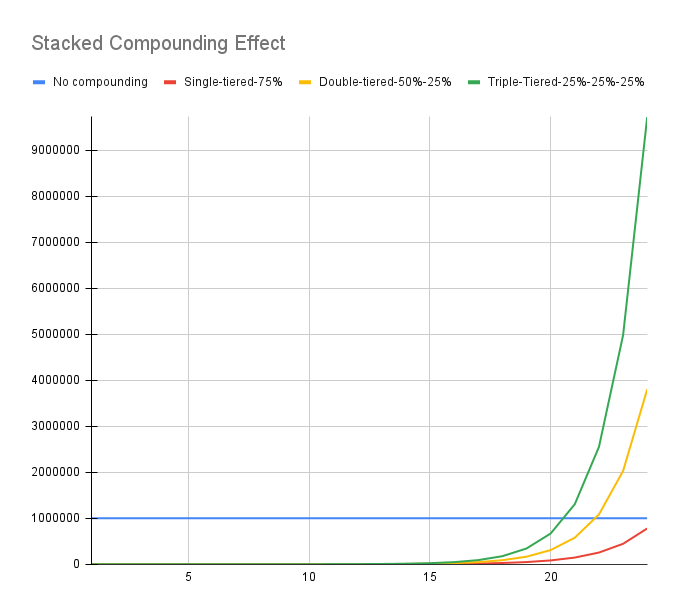
We all understand compounding in theory: reinvesting growth so that it builds upon itself over time. But what if you could compound on top of your compounding—layering growth within the same period? That’s what we call stacked compounding, and it has the power to create truly exponential outcomes. The Visual That Says It All Take a look at the chart above, which compares four growth paths over 24 months: No Compounding (Flat Line) – Value remains stagnant. Single-Tiered Compounding (75%) – Traditional, strong growth. Double-Tiered (50% + 25%) – Two sequential layers of growth. Triple-Tiered (25% + 25% + 25%) – Three layers of growth stacked in a single cycle. Although each compounding path uses the same total growth rate (75%), the outcome is dramatically different. The triple-tiered model outpaces all others—by millions. Why Stacking Beats Simple Compounding Each layer in stacked compounding compounds on an already-increased base: First layer grows the base. Second layer compounds on that. Third layer accelerates even further. The result is compounding over compounding—and it explains why triple-tiered growth shoots upward while traditional growth lags behind. The Patience Factor: When Results Really Start to Show But here’s the catch: stacked compounding doesn’t look impressive at first. For the first 10–12 months, results are modest. Months 15–18 show the first major gains. By months 20–24, the curve explodes—especially in the triple-tiered model. This is what James Clear calls the “Valley of Latent Potential.” Your efforts are working, but the results are still building beneath the surface. If you give up too soon, you miss the magic. Business Takeaway: Stack Everything Stacked compounding isn’t just for investing—it’s a philosophy for business growth: Marketing: Follow an ad with email → retargeting → webinar invite. Sales: Outreach → personalized demo → special offer. Product: Deliver value → educate → upsell. Each touchpoint stacks, amplifying the one before it. Final Word: Stack. Wait. Win. Stacked compounding shows that order matters—and so does patience. The biggest wins don’t come from a single big move. They come from layered, consistent action that builds on itself over time. Don’t just grow. Stack your growth. And give it time.
What the Persian King Didn’t See Coming — The Power of Exponential Thinking
When the ancient game of chess was invented, the king of Persia (or India, depending on the version) was so impressed that he offered the game’s creator any reward he wished. The inventor’s request seemed modest: “Place one grain of rice on the first square of the chessboard, two on the second, four on the third, and so on—doubling the amount on each of the 64 squares.” The king laughed at the simplicity of the request and granted it immediately. But soon, his court mathematicians realized the true cost: By the 10th square: over 500 grains By the 20th: over 500,000 grains By the 40th: over 550 billion grains By the 64th square: 18.4 quintillion grains of rice That’s more rice than exists on Earth. The king was stunned—and unable to fulfill the promise. The Lesson? Exponential growth always starts quietly—then compounds explosively. In business, we often think linearly: add a client, launch a feature, and fix a workflow. But when systems are designed to scale—when innovation, efficiency, and integration are aligned—the results multiply, not just add. That’s why companies with compounding ecosystems, like ClinicMind, don’t just grow—they accelerate. At ClinicMind, we see this lesson play out across the practices we serve: A provider implements our EHR—they save time. Then they launch Credentialing and PatientHub—their visit volume increases. Then they turn on AI Scribe—their documentation fatigue disappears. Then they add RCM—their cash flow improves. Each solution alone brings value. But together, they create compounding gains across revenue, workflow, and patient retention. Like grains on the chessboard, every new component multiplies the return on the one before it. That’s what makes ClinicMind more than a product. It’s a growth engine—designed to scale with each client’s ambition. Next time you think a small improvement isn’t worth it, remember the chessboard. You might be on square 4 now. But square 64 is coming sooner than you think.
Understanding the AMA CPT Code Licensing Fee on Your ClinicMind Invoice
What Are CPT Codes and Why Are They Essential? Current Procedural Terminology (CPT codes), developed and maintained by the American Medical Association (AMA), serve as the standardized system for reporting medical, surgical, and diagnostic procedures. These codes are critical for accurate billing, documentation, and communication between healthcare providers and insurance payers. Why Is There a Licensing Fee for CPT Codes? The AMA owns the copyright to CPT codes, and any EHR, billing system, or practice management platform that integrates them must obtain a license. This ensures: Ongoing maintenance and updates to reflect medical advancements. Compliance with regulatory requirements for accurate coding. Uniformity in medical billing to prevent discrepancies. Any entity that uses, references, or displays CPT content is required to obtain a license from the AMA or an authorized distributor. This includes electronic health record (EHR) systems, practice management software, and other healthcare applications incorporating CPT codes. How Does This Impact ClinicMind Users? ClinicMind integrates CPT codes within its platform to streamline your billing and documentation processes. To comply with AMA licensing requirements, ClinicMind incurs an annual per-provider fee for the use of these codes. Consequently, this cost is reflected in your invoice as the “AMA CPT Code Licensing Fee.” This practice is standard across the industry, as all users of CPT content are expected to obtain the appropriate license for their use case (References below). Starting May 1, ClinicMind invoices will reflect two new AMA CPT licensing fee line items: A one-time charge covering up to three years of past CPT code usage. A monthly charge for the current billing period. Although the AMA charges this fee annually, ClinicMind has structured it into 12 monthly installments for ease of payment. Note: This is a pass-through cost—ClinicMind does not add any markup or service fees on top of the AMA license. Frequently Asked Questions (FAQ) Q1: Do all providers need to pay for CPT code licensing? Yes. Any clinician using CPT codes in their practice—whether for insurance billing, out-of-network claims, or clinical documentation—must have a valid AMA license. Q2: Is this fee unique to ClinicMind? No. All EHR, practice management, and billing platforms that include CPT codes must pay licensingfees to the AMA. Q3: How are licensing royalties determined? The AMA applies royalties for the use of CPT codes based on the type of product in which the CPT content is used and the type of user of the product. Q4: Does this fee apply per practice or per clinician? The AMA fee is typically charged annually per practice type, regardless of the number of clinicians yearly, ensuring each provider has access to an up-to-date, compliant CPT code set. Q5: Can I opt out if I don’t use insurance billing? No. Even if you don’t bill insurance, CPT codes are still required for standardized documentation, out of-network claims, and medical record accuracy. Q6: Will my administrative staff be charged the AMA fee? No, the fee applies only to members of your practice who have a clinician role in ClinicMind. Q7: Can I pay the AMA directly instead of through ClinicMind? While you can purchase a CPT license directly from the AMA, it won’t cover ClinicMind’s use of CPT codes within our EHR. Why This Matters Understanding the AMA CPT licensing fee helps providers ensure compliance, maintain billing accuracy, and contribute to the ongoing development of the healthcare industry’s standard coding system. If you have any questions about how this applies to your ClinicMind account, please reach out to our support team. Summary of Key Points: CPT codes are AMA-owned and require a paid license for use in EHRs. ClinicMind, like other platforms, must pass this cost through to providers. The AMA charges annually, but ClinicMind offers monthly payments. This fee applies per clinician and is a mandatory compliance cost. No service fees or markups are added—ClinicMind only passes the direct AMA cost. By structuring the AMA CPT licensing fee transparently and fairly, ClinicMind ensures that our users stay compliant without unnecessary financial burden. References 1. simplepractice.com AMA fee FAQs https://support.simplepractice.com/hc/en-us/articles/28804985196173-AMA-fee-FAQs 2.Therapybrands.com FAQ Regarding Recent CPT Code Licensing Fees (Fusion Enterprise) https://support.therapybrands.com/s/article/4409539675028-FAQ-Regarding-Recent-CPT-Code-Licensing-Fees-Fusion-Enterprise 3.Practicefusion.com CPT License FAQ https://help.practicefusion.com/s/article/CPT-License-FAQ 4.en.wikipedia.org Current Procedural Terminology April 10, 2024 — The Current Procedural Terminology (CPT) code set is a procedural code set developed by the American Medical Association (AMA). It is maintained by the CPT Editorial Panel. The CPT code set describes… 5.ama-assn.org Licensing CPT for AI FAQs – American Medical Association March 6, 2025 — Find out the answers to frequently asked questions about licensing CPT for augmented intelligence (AI). 6.ama-assn.org CPT® licensing frequently asked questions (FAQs) October 10, 2024 — Any entity using CPT content anywhere worldwide must have a license authorizing the use of CPT code set from the AMA or an authorized distributor. 7.AMA Compliance Internal End User License Agreement Royalty Rates for 2025, 2026 … July 22, 2024 — A minimum royalty of $100.00 applies for each annual release of the CPT Standard Data File in Covered Products licensed under the Health Plan Model. 8.AMA Compliance Notice: Standard CPT Distribution Pricing Schedule 2024 June 20, 2024 — AMA’s Version of Healthcare Common Procedure Coding System, Level II ; January 1, 2024 ; $19.00 for each User. 9.ama-assn.org CPT® Royalties & Licenses – American Medical Association CPT royalties and licensing ensure you are compliant with the correct uses of CPT code data. Get the latest on CPT codes from the AMA. 10.ama-assn.org CPT® Codes – American Medical Association Here you’ll find the AMA’s latest updates on new CPT codes, code proposals and revisions, CPT code reimbursement and more. 11.ama-assn.org [PDF] CPT Licensing Categories for Licensees Imposing Fees on Physicians WHEREAS, The AMA owns intellectual rights to the CPT code and is legally authorized to. 8 charge just and fair fees for the use of its intellectual property; … 12.ama-assn.org FAQ: Editorial Panel & CPT® overview – American Medical Association For information on the license process, proper use, fees and applications, please visit our licensing page.
Chiropractic Credentialing Checklist: A Step-by-Step Guide
Credentialing is a critical process for chiropractors looking to accept insurance and expand their patient base. Without proper credentialing, chiropractors risk delays in reimbursement or outright claim denials. Whether you’re a new chiropractor or updating your credentials, following a structured checklist can help ensure a smooth process. Why Credentialing Matters for Chiropractors Credentialing verifies your qualifications and allows you to bill insurance companies for your services. It’s different from payer enrollment, which is the process of getting linked to specific insurance networks. (For more on this distinction, check out How Is Insurance Payer Enrollment Different From Credentialing for Chiropractors?) Proper credentialing also helps avoid common issues like network rejections, which can occur if your paperwork is incomplete or outdated (5 Reasons Chiropractors Can Be Rejected by Insurance Company Networks During the Credentialing Process). The Chiropractic Credentialing Checklist 1. Gather Essential Documents State Chiropractic License (must be current and in good standing) National Provider Identifier (NPI) Malpractice Insurance Certificate Chiropractic School Diploma Continuing Education Credits (if applicable) Tax Identification Number (TIN) or Employer Identification Number (EIN) 2. Get Your CAQH Profile in Order Most insurance companies use the Council for Affordable Quality Healthcare (CAQH) for credentialing verification. Ensure your CAQH profile is: ✅ Updated with the latest practice information ✅ Complete with all required documentation ✅ Re-attested every 120 days to stay active Learn more about why credentialing in medical billing systems matters: Credentialing in Medical Billing Systems. 3. Apply to Insurance Networks Once you’ve completed your CAQH profile, you’ll need to apply to individual insurance companies and government payers like Medicare and Medicaid (Medicare and Medicaid Credentialing). Each payer has its own credentialing process and timelines, so be prepared for some variability. 4. Follow Up on Your Applications Most insurance companies take 60-120 days to process credentialing applications. Contact payers regularly to check your application status. Be prepared to submit additional documentation or clarifications if needed. Want to streamline your applications? Read 6 Steps to Credentialing with Insurance Companies for Chiropractors. 5. Get Linked to Your Practice Credentialing isn’t just about getting approved—it’s about ensuring you are properly linked to your practice so that your reimbursement claims aren’t denied. This is a common mistake that can lead to months of lost revenue if not handled correctly. For more details on potential pitfalls, check out Traversing the Credentialing Maze. 6. Maintain and Renew Your Credentials Credentialing isn’t a one-time process. Insurance companies require ongoing verification, including: License renewals Malpractice insurance updates CAQH re-attestation Keeping your practice details up to date Staying on top of renewals ensures staff efficiency and fewer reimbursement delays (The Impact of Credentialing on Staff Efficiency). Make Chiropractic Credentialing Hassle-Free with CredEdge Credentialing can be time-consuming and complicated, but CredEdge by ClinicMind simplifies the process. We handle everything from initial credentialing to ongoing renewals, document management, and payer follow-ups—so you can focus on patient care instead of paperwork. ✅ Flat-rate pricing—no hidden fees ✅ Full credentialing lifecycle management ✅ Stay linked, updated, and always in good standing Don’t let credentialing delays impact your practice. Get started with CredEdge today. Take the hassel out of credentialing off your plate! Book a consultation to learn more Book a Consultation
Finding Purpose in Private Practice: A Four-Part Exploration – (Part 1: Uncovering the Role of Purpose and Mission)
Introduction In healthcare, success often gets measured by external markers: the number of patients seen, the caliber of equipment purchased, or the efficiency of billing systems. While these are important, focusing on them in isolation can lead to a nagging sense that something more fundamental is missing. This something—often described as purpose or mission—is what unifies all those daily decisions into a coherent, meaningful path (Collins & Porras, 1994; Sinek, 2009). In this first post, we’ll unpack why purpose and mission are crucial in private practice. We’ll also introduce you to Joseph and Bonnie, two physical therapy clinic owners facing a crisis that can teach us a lot about how quickly things unravel when purpose drifts out of sight. 1. More Than a Collection of “Right” Decisions Healthcare professionals pride themselves on making “right” decisions: Hiring the right people and firing those who prove to be a poor fit Investing in top-tier equipment for diagnostics or therapy Seeking expert consultants to streamline operations Emphasizing personal well-being with exercise, nutrition, and adequate rest All of these actions are vital. However, purpose (or “mission” in a business context) weaves these separate initiatives into a bigger picture that resonates with patients, staff, and owners alike (Osterwalder & Pigneur, 2010). Without a unifying purpose, each “right” decision stands alone—like puzzle pieces without a completed image to guide you. Healthcare’s Missing Word In business, it’s “mission statement.” In personal development, it’s “purpose” or “calling.” In healthcare, we often assume our altruistic drive to help patients is enough. But a clearly articulated purpose transcends assumptions, serving as a daily reminder of why we do what we do (Schwartz, Simon, & Bessen, 2018). 2. Purpose as the “Hidden Substance” The text draws a parallel between “empty space” and purpose. Even when things appear empty, something profound exists beneath the surface. In healthcare, this intangible element is your guiding mission—the principle that tells you and your team, “This is why we opened our doors; this is what makes every patient interaction matter” (Kotter, 2012). Patient Engagement: When you say to a patient, “We’re on a mission together,” you invite them into a collaborative relationship, boosting compliance and trust. Team Cohesion: A mission grounds staff members, offering them a sense of belonging and direction (DeCelles, 2020). 3. Introducing Joseph and Bonnie Joseph and Bonnie own a physical therapy clinic in Utah. Their once-thriving practice now struggles under financial strain and personal stress. They’ve let their health slip, gained weight, and even their children are showing signs of distress. Despite being clinically competent, they’ve lost the spark that made their work meaningful. Why Their Story Matters Real-Life Consequences: It’s not just about losing money—patients suffer, staff morale dips, and personal relationships fray. Relatable Crisis: Many healthcare professionals eventually face a moment where their why feels blurred, replaced by endless to-do lists. Conclusion Healthcare practice ownership involves countless “right” decisions, but those choices need a compass to ensure they lead somewhere fulfilling. Purpose acts as that compass, anchoring each decision to a larger mission that resonates on both professional and personal levels (Sinek, 2009). In the next part, we’ll delve deeper into Joseph and Bonnie’s story, illustrating what happens when survival mode replaces purposeful practice.
Honoring the Legacy of Dr. Gregg Friedman
Play Video It is with great sorrow that we share the passing of Dr. Gregg Friedman, a beloved chiropractor, innovator, and leader who left an indelible mark on the chiropractic profession. Gregg was more than just a practitioner—he was a visionary dedicated to improving patient care and empowering providers with better tools, strategies, and systems. At ClinicMind, we had the privilege of working alongside Gregg as he served as our Chief Chiropractic Officer. His passion and expertise played a crucial role in advancing chiropractic management, and his legacy lives on through BulletProof—a groundbreaking system he developed to support chiropractors in delivering high-quality, efficient care. In 2023, ClinicMind had the honor of acquiring BulletProof, ensuring that his pioneering work continues to serve the chiropractic community. But Gregg was more than his professional achievements. He was a person of incredible warmth, humor, and resilience. Even in the face of immense challenges, he remained focused on solutions, on the future, and on making a difference. His ability to inspire those around him was unmatched, and his impact will be felt for years to come. As we mourn the loss of a great friend and colleague, we also commit to carrying forward his vision. ClinicMind will continue to support the chiropractic community in the spirit of innovation and dedication that Gregg embodied. Our deepest condolences go out to Gregg’s family, friends, and everyone who had the privilege of knowing him. His influence will not fade—his work, his wisdom, and his relentless drive will continue to inspire us all. Rest in peace, Gregg. Your legacy lives on.
What Are General Chiropractic Business Costs?
Running a chiropractic practice isn’t just about patient care—it’s also about managing the business side efficiently. From billing services to software costs and compliance fees, many chiropractors wonder if they’re overpaying or missing critical expenses in their operations. A recent discussion on Reddit highlighted the question: Am I paying too much for my billing company? The reality is, billing is just one part of the equation—there are multiple costs that chiropractors must consider to maintain a successful and profitable practice. How Much Does It Cost to Open a Chiropractic Office? Starting a chiropractic practice involves several upfront and ongoing expenses. The total cost can vary significantly based on location, equipment needs, and staffing requirements. Some key costs include: Office space rental or purchase – Lease rates vary widely, but expect to pay anywhere from $1,500 to $6,000 per month depending on location and size. Equipment and furnishings – Adjusting tables, diagnostic tools, and office furniture can add up to $20,000 to $50,000 or more. Initial marketing and branding – Website development, local advertising, and signage can cost $5,000 to $15,000 to establish a strong presence. Licensing, credentialing, and insurance – State licensure, malpractice insurance, and credentialing with payers can add another $3,000 to $10,000 in initial costs. These startup expenses are in addition to the ongoing operational costs covered in this post. Careful planning and budgeting are essential to ensure a smooth launch and sustainable growth. Breaking Down the Costs of Running a Chiropractic Practice 1. Billing & Revenue Cycle Management Many chiropractors outsource their billing, with costs ranging anywhere from 5%–10% of collections or a flat monthly fee of $1,000–$3,000. While outsourcing can be more efficient than in-house billing, overpaying for a service that doesn’t maximize reimbursements can hurt your bottom line. With ClinicMind’s Billing Services, you get a comprehensive revenue cycle management solution that ensures claims are processed correctly, reducing denials and improving cash flow. Instead of wondering if you’re overpaying, you can be confident that every claim is being optimized for maximum reimbursement. 2. Practice Management Software & EHR Systems A robust EHR system is essential, but some chiropractors pay $300–$800 per month for outdated or limited software. Others forget to account for the hidden costs of using multiple disconnected platforms, which lead to inefficiencies and increased administrative work. ClinicMind’s All-in-One EHR eliminates the need for multiple platforms by integrating scheduling, documentation, billing, and compliance tracking into one system—saving time and reducing costs. 3. Credentialing & Insurance Payer Contracts If you accept insurance, proper credentialing is critical. Fees for third-party credentialing services range from $150 to $500 per provider per payer, and errors in credentialing can delay payments for months. With ClinicMind’s Credentialing Services, you ensure that your practice is enrolled correctly with the right payers, avoiding costly delays and lost revenue. 4. Staffing & Payroll Labor is often the largest expense for a chiropractic practice. Salaries for front desk staff, billing personnel, and office managers add up quickly. Some practices opt for part-time employees, but hiring and training can be costly if turnover is high. By outsourcing administrative functions to ClinicMind’s Virtual Office Services, you can reduce staffing costs while ensuring efficient practice operations. 5. Marketing & Patient Acquisition Many chiropractors underestimate marketing costs. A well-rounded strategy—including website management, SEO, and digital advertising—can range from $500 to $5,000 per month depending on the size of the practice and competition in the area. ClinicMind’s Marketing Services help chiropractors attract and retain more patients without overspending on ineffective marketing strategies. 6. Compliance & Risk Management HIPAA compliance, documentation audits, and risk management aren’t optional—but they’re often overlooked. Chiropractors might spend $1,000–$3,000 annually on compliance services or risk expensive penalties for non-compliance. With ClinicMind’s Compliance Solutions, your practice stays protected, avoiding unnecessary fines and liabilities. Are You Overspending or Missing Key Costs? Managing expenses effectively ensures long-term success for your practice. By evaluating your costs across billing, software, credentialing, staffing, marketing, and compliance, you can determine where you’re overspending—or where gaps might be costing you money. Want to see how outsourcing can save you time and money? Meet with a ClinicMind consultant today to explore how we can streamline your operations and reduce unnecessary expenses.
Chiropractic Credentialing: How To Avoid Delays & Get Paid Faster
For chiropractors, navigating the complex world of credentialing can be a daunting task. Without proper credentials, practices can’t receive their reimbursements, delaying patient care, and missing opportunities for growth. Whether you’re a solo chiropractor, part of a group practice, or expanding your network, having a streamlined credentialing process is essential. That’s where ClinicMind’s CredEdge comes in—a comprehensive solution designed to simplify chiropractic and mental health professional credentialing, ensuring accuracy, efficiency, and compliance. The Importance of Chiropractic Credentialing Credentialing is more than just paperwork—it’s a crucial step in establishing your legitimacy with insurance companies, government payers like Medicare and Medicaid, and other healthcare organizations. Without proper credentialing, you won’t be able to bill insurance providers, which directly impacts revenue and patient access to care. The process involves verifying education, training, licenses, and work history, among other key qualifications. However, the manual credentialing process is time-consuming and prone to errors, and delays. If not handled correctly, chiropractors can face costly denials or contract terminations. Common Challenges in Chiropractic Credentialing Many chiropractors struggle with: Long Processing Times – It can take 90-120 days to complete credentialing, and errors in applications can cause further delays. Complicated Requirements – Each payer has unique criteria for credentialing, making the process overwhelming. Medicare & Medicaid Complexity – Government payer credentialing involves extensive paperwork and ongoing compliance. Renewals & Re-certifications – Chiropractors must stay on top of expiring credentials, insurance renewals, and compliance updates. How CredEdge Streamlines Credentialing CredEdge is ClinicMind’s advanced credentialing service that takes the burden off your shoulders, ensuring a seamless experience from start to finish. 1. Full-Service Credentialing Help From initial applications to ongoing maintenance, CredEdge handles the entire process—including Medicare and Medicaid credentialing. 2. Faster Credentialing & Fewer Errors CredEdge’s automated tracking system minimizes human error and accelerates processing times, so you can start billing sooner. 3. Multi-Payer Credentialing Expertise Our team has experience working with private insurance providers, Medicare, Medicaid, and worker’s compensation programs, ensuring you’re credentialed with the payers that matter most. 4. Compliance & Ongoing Support With real-time monitoring, we alert you when renewals are due and ensure you stay compliant with payer requirements—reducing the risk of credentialing lapses. Why Choose ClinicMind’s CredEdge? Time Savings – Focus on patient care instead of administrative tasks. Revenue Optimization – Avoid reimbursement delays and denials. Expert Support – Work with credentialing specialists who understand chiropractic needs. Seamless Integration – If you choose to use ClinicMind’s EHR and billing system, it’s fully integrated for a streamlined practice management experience. Our team also collaborates with your billing department and credentialing experts to ensure your office operates as a whole. Get Started Today Credentialing shouldn’t be a roadblock to your success. With ClinicMind’s CredEdge, you can ensure your chiropractic practice is credentialed quickly, correctly, and compliantly—allowing you to focus on what matters most: your patients. Contact us to learn more about CredEdge and get paid faster today! Take the hassel out of credentialing off your plate! Book a consultation to learn more Book a Consultation
Welcoming Dr. Igor Sobol to the Advisory Board

Healthcare practice owners face numerous challenges, including patient attraction, retention, staffing, regulatory compliance, and payer adversity. When left unaddressed, these obstacles hinder practice revenue, growth, and profitability. We are excited to welcome Dr. Igor Sobol, MD, PhD, to our Advisory Board. With a strong background in both medical practice and research, Dr. Sobol has played a pivotal role in integrating technology with healthcare delivery. At ClinicMind, we empower healthcare providers with scalable solutions to streamline operations and enhance efficiency. Dr. Sobol’s appointment marks a significant advancement for ClinicMind users. His insights will enhance our products, enabling providers to optimize workflows, improve patient engagement, and navigate the complex healthcare landscape more efficiently. His deep understanding of healthcare operations and emerging technologies will guide product development and strategic initiatives, reinforcing our commitment to excellence. ClinicMind continues its mission to transform healthcare through smart, data-driven solutions, equipping providers with the tools they need to succeed in an evolving industry. Read the Full Announcement Check out the full press release here: ClinicMind Welcomes Dr. Igor Sobol to Its Advisory Board.
Credentialing in Medical Billing Systems

Credentialing in medical billing is crucial for ensuring patient safety and maintaining the quality of care provided by healthcare providers. This process involves verifying providers’ qualifications, competence, and eligibility, playing a vital role in effective revenue cycle management. In 2021, the Credential Management Solutions Market had a valuation of USD 833.45 Million. Projections indicate that it is expected to reach USD 2526.34 Million by 2030, experiencing a compound annual growth rate (CAGR) of 17.7% from 2022 to 2030. The rising cyber threat risk has spurred demand for skilled experts, credential management solutions, and IT security compliance software in businesses and organizations. (Credential Management Solutions Market Size, Share, Trends & Forecast, 2023) Figure 1. Global Credentialing Management Solutions Market https://www.verifiedmarketresearch.com/product/global-credential-management-solutions-market-size-and-forecast-to-2025/ Medical Billing Systems in Credentialing Medical billing systems are critical components of healthcare operations. They are used to submit and follow up on claims with health insurance companies to receive payment for services rendered by a healthcare provider. The role of medical billing systems in credentialing is quite significant. Provider Information: Medical billing systems hold essential information about providers, including their credentials. This information is necessary for filing claims and verifying a provider’s ability to provide certain services. Claims Processing: One of the key steps in processing medical claims involves verifying the provider’s credentials. If a provider is not properly credentialed with a particular payer, claims for services rendered can be denied, resulting in lost revenue. Regulatory Compliance: Medical billing systems help maintain compliance with healthcare regulations, including credentialing-related ones. By ensuring providers are credentialed properly, the systems help prevent fraudulent claims and avoid potential legal issues. Integrating credentialing into medical billing systems can streamline workflows, improve accuracy, and increase efficiency. The integration can occur in various ways: Data Sharing: Medical billing systems can be configured to share data with credentialing systems, allowing for real-time updates of provider information. Automated Verifications: With the integration, systems can automatically verify a provider’s credentials during claim processing, flagging any issues for immediate attention. Credentialing Updates: Updates to a provider’s credentials can be automatically reflected in the billing system, reducing the chance of claim denials due to outdated credential information. Scheduling and Alerts: Medical billing systems can help manage credentialing timelines, offering reminders when it’s time for providers to renew their credentials, thus maintaining their eligibility with payers. Key Facts about Credentialing Applications Credentialing applications in the US healthcare system involve a significant volume of submissions. However, the success rate varies, with some applications failing to meet the requirements. The timeline for the credentialing process typically spans around 90-120 days, including the verification and contracting phases; per provider, there are 18 payers. For every 5 payer applications, 25 working hours of the hospital staff and physicians are consumed. Also, approximately 85% of the applications still need to be completed. (Shah, 2023) Figure 2. Basic Credentialing Facts Challenges in the Credentialing Process Incomplete or Inaccurate Documentation Incomplete or inaccurate documentation is a common challenge in the credentialing process. Thoroughly reviewing the application materials and seeking assistance, if needed, can help mitigate this challenge. Maintain clear records of all documentation submitted and maintain copies for reference and future updates. Insufficient Qualifications Meeting specific qualifications, such as experience, licenses, certifications, or exam scores, is crucial for successful credentialing. Regularly reviewing and updating qualifications, participating in continuing education, and seeking professional development opportunities help providers stay current and fulfill credentialing requirements. Lack of Adherence to Credentialing Standards Adhering to credentialing standards is essential for a smooth credentialing process. Familiarize themselves with the specific standards and ensure they comply with professional conduct, ethical behavior, and patient safety requirements. Regularly reviewing the credentialing standards and seeking ongoing education on changes or updates to these standards promote ongoing compliance and avoid potential challenges. Inadequate Professional References Successful credentialing requires credible professional references highlighting the provider’s skills, knowledge, and abilities. Establish professional relationships and seek references from respected individuals who can vouch for their qualifications and competence. Engage in professional networks to facilitate the collection of robust references. Disciplinary Actions or Malpractice History Providers with a history of disciplinary actions or malpractice may face challenges during credentialing. Credentialing organizations are concerned about the provider’s competence and safety. Prepare to address any disciplinary or malpractice history concerns and provide explanations or evidence of corrective actions. Seeking legal counsel or assistance from credentialing experts can help providers navigate these challenges effectively. (Shah, 2023b) Common Documents and Information Required for Credentialing Applications Typically, credentialing applications include: Educational Background and Training Documentation: Healthcare providers must submit comprehensive documentation that validates their educational background and training. This includes transcripts, diplomas, degrees, and records of specialized training, fellowships, and continuing education courses. Accuracy in these documents is crucial as they reflect the provider’s expertise in their specific field of practice. Licensure and Certification Details: Credentialing applications typically seek information about the provider’s current and past licensure status. This encompasses their medical license, board certifications, and any history of disciplinary actions or license restrictions. Malpractice History and Insurance Coverage: Disclosure of malpractice history, including any claims, settlements, or judgments, is standard procedure in credentialing applications. This information helps assess the provider’s risk profile and ability to deliver safe, high-quality care. Providers must also furnish proof of malpractice insurance coverage or alternative means of financial responsibility. Professional References and Recommendations: Credentialing applications often require professional references from colleagues, supervisors, or others familiar with the provider’s clinical practice. These references offer insights into the provider’s professional conduct, clinical skills, and teamwork abilities. Recommendations from respected professionals carry significant weight in the credentialing process and positively impact the provider’s application. Practitioner Data Bank and National Provider Identifier (NPI) Registration: Providers are obliged to disclose any adverse actions or reportable events as required by the National Practitioner Data Bank (NPDB). This includes malpractice settlements, disciplinary actions, or exclusions from federal healthcare programs. Additionally, providers must obtain a National Provider Identifier (NPI) and include it in their credentialing application. The NPI standardizes provider identification across healthcare systems and ensures accurate tracking of provider activities.
