
ClinicMind vs. TherapyNotes & SimplePractice — Why Simplicity Isn’t Always Smart
When you’re running a behavioral health practice, it’s easy to get lured in by EHR platforms that promise “simple” setup and sleek interfaces. And to their credit, TherapyNotes and SimplePractice deliver on those promises — up to a point. But if you’re trying to grow your practice, maximize reimbursements, and reduce admin overload, simplicity alone won’t cut it. Here’s why more mental health professionals are moving to ClinicMind — a smarter, fully integrated system built to scale. The Problem with Partial Solutions TherapyNotes and SimplePractice are widely used for their easy scheduling, notes, and billing. But beneath the surface, there are critical limitations: Feature TherapyNotes SimplePractice ClinicMind Credentialing Services ✅ Yes ❌ No ✅ Yes Fully Integrated EHR + RCM ❌ No ❌ No ✅ Yes AI-Powered Features ❌ No ❌ No ✅ Yes Mobile Patient Experience ⚠️ Browser-based only ✅ App available ✅ Fully optimized Customizable Notes ❌ Limited ❌ Limited ✅ Full customization Virtual Front Desk ❌ No ❌ No ✅ Yes Measurement-Based Care ❌ No ❌ No ✅ Yes Why “Easy” Isn’t Always Efficient TherapyNotes and SimplePractice work well for providers who want a basic EHR with limited bells and whistles. But here’s the catch: You’ll still have to outsource or manually manage credentialing, a key revenue driver. There’s no automation to reduce manual admin tasks like follow-ups, reminders, or data entry. You’ll need to juggle separate tools or add-ons for billing, telehealth, intake, and outcomes tracking. Patient engagement is often limited to browser-based portals or basic reminders. ClinicMind: The All-in-One EHR That Grows With You ClinicMind offers a fully integrated, AI-powered EHR + RCM platform built specifically for behavioral health providers. That means: Credentialing is included, so you can grow your payer list and patient pool. RCM, billing, and EHR are seamlessly connected, with no need for patchwork integrations. AI tools support everything from smart documentation to automated patient reminders. Your staff and clients enjoy a fully mobile-optimized experience, from scheduling to secure messaging. What Users Are Saying ClinicMind: “Super helpful and supportive… Everything’s in one place. Their team is like an extension of ours.” TherapyNotes: “Easy to use, but customer service is lacking and limited feature set.” SimplePractice: “Great for small practices, but once you grow, it starts to feel rigid.” Final Takeaway If you’re a solo therapist looking for a basic tool, TherapyNotes or SimplePractice might work — for now. But if you’re ready to grow, streamline your back office, and reclaim hours of lost admin time each week, ClinicMind is built for the next chapter of your practice. Ready to see it in action? Schedule an intro and explore how ClinicMind helps practices like yours scale with ease.
Behind the Scenes with Dr. Joe Betz: Quietly Reshaping the Future of Chiropractic
Most people think of leadership as a spotlight role—speeches, stage time, visibility. But in the chiropractic world, one of its most influential leaders is working powerfully from behind the curtain. Dr. Joe Betz, newly appointed President of the International Chiropractors Association (ICA), exemplifies a different kind of leadership: strategic, understated, and deeply effective. In a revealing conversation on ClinicMind’s webinar podcast, Dr. Betz shares how his quiet leadership style is exactly what the profession needs—especially in research, global advocacy, and public health policy. From Quiet Start to Global Advocate Dr. Betz never set out to lead from the front. A visit to Life University, inspired by a friend’s excitement, introduced him to chiropractic. After launching his Idaho practice in 2001, Betz quickly took on leadership roles—locally, then nationally—eventually serving over a decade on the ICA board before becoming its 21st president. Though more comfortable behind the scenes, he stepped into the presidency when the ICA needed both vision and steadiness. “These positions are all volunteer,” he explained. “It takes someone who understands the system and believes in the mission.” The ICA has long worked to protect chiropractic’s identity as a drug-free, surgery-free profession—often without fanfare. From testifying at state legislatures to advocating for Medicare reform, the ICA plays a vital role. Betz now aims to increase transparency so members understand that impact. Aligning with Federal Change and Modern Tools A key development during Betz’s tenure has been new engagement with Robert F. Kennedy Jr.’s health team. Betz describes “regular meetings” and shared views on natural health. “This opens doors we’ve never even peeked into before,” he said. He’s also pushing modernization in chiropractic research. Through CBP and the Chiropractic Future initiative, Betz supports development of a data lake—powered by EHR systems like ClinicMind—that enables large-scale, real-world outcomes research. “We’re not a pharmaceutical company with endless budgets,” Betz said. “But now we can produce research that validates care models and improves outcomes.” Global Ambitions, Local Roots The ICA is also expanding internationally. At a recent World Federation of Chiropractic meeting with over 50 countries, Betz saw firsthand the challenge of gaining recognition in regions where chiropractic is unlicensed or misunderstood. “In many countries, it’s not even known,” he explained. “And in some, untrained individuals damage our reputation.” ICA is helping build awareness, regulation, and pathways to legitimate education—but the work is slow, requiring long-term commitment and funding. A Call to Step Up For Betz, the profession’s future depends on collective effort. “Join. Donate. Bring in a colleague,” he said. As the ICA approaches its 100th anniversary, he’s proving that true leadership doesn’t need a spotlight—only dedication to moving the profession forward. Want the Full Conversation? To dive deeper into Dr. Joe Betz’s insights on leadership, policy, and the future of chiropractic, visit the ClinicMind Events Page and unlock exclusive access to the full interview. Sign up now to stream the full webinar and stay connected with more thought leadership from chiropractic’s top voices.
The Mental Health Crisis in Healthcare: Why We Need a New Approach
Mental health has long been the silent cornerstone of overall well-being, yet the infrastructure supporting mental health providers remains fractured, underfunded, and overwhelmed. With a growing demand for services, clinicians face intense pressure just to keep up, let alone thrive. According to the National Institute of Mental Health (2023), the U.S. is grappling with a significant mental health workforce shortage. Providers report burnout at alarming rates due to increasing caseloads, administrative demands, and insufficient resources. The World Health Organization (2022) adds that mental health care access gaps remain a global crisis, with millions going untreated due to a lack of scalable, sustainable care models. From my own experience consulting with practices across the country, these issues aren’t theoretical—they’re daily realities. Providers are spending more time fighting insurance denials, manually entering data into outdated systems, and managing operations without the support they need. These pain points aren’t just frustrating; they put both provider well-being and patient outcomes at risk. As Thomas Insel (2022) writes in Healing: Our Path from Mental Illness to Mental Health, “We need to stop treating mental illness and start building mental health.” That shift requires more than just good intentions. It demands leadership, operational excellence, and a renewed focus on systems that support—not sabotage—care delivery. So what’s the solution? Strategic practice management. The right infrastructure can transform how mental health care is delivered. From streamlined workflows and simplified insurance processes to intuitive technology and leadership that supports clinicians, we have the tools to build practices that thrive. At ClinicMind, we’re not just focused on making software. We’re building a movement—one that centers around helping providers succeed so they can do what they do best: help others. This series is dedicated to exploring how we get there. Stay tuned for Chapter 2, where we dive into the hidden cost of workflow overload and how to fix it. Sources: National Institute of Mental Health (NIMH). (2023). Workforce shortages and provider burnout. World Health Organization (WHO). (2022). Global mental health care access gaps. Insel, T. (2022). Healing: Our Path from Mental Illness to Mental Health.
Scaling a Healthcare Practice Does Not Have to be Difficult
Most providers eventually hit a growth ceiling but not always for the reasons you’d expect. Some struggle to bring in enough patients. Others have the volume but can’t scale because of inefficient systems, disconnected tools, and administrative overload. Either way, growth becomes harder than it should be—and the passion that launched the practice starts to fade under daily pressure. At ClinicMind, we’ve worked with thousands of practices. And we’ve seen how growth stalls when tools can’t keep up with ambition. What’s Really Holding Practices Back Sometimes, it’s patient flow.Sometimes it’s internal chaos.But most often, it’s a combination of both. One system for scheduling Another – for documentation A separate billing solution Yet another – for patient communication or credentialing Each tool works in isolation—but they don’t work well enough together. Time is lost in handoffs, data is duplicated, and support becomes a maze. And when you’re trying to grow, those cracks widen fast. ClinicMind EHR 2.0: Designed to Grow with You ClinicMind 2.0 isn’t just a fresh interface. It’s part of an integrated platform built for real, sustainable growth—whether you’re trying to attract more patients, open a second location, or improve cash flow without adding more staff. How EHR 2.0 Powers Practice Growth ClinicMind EHR 2.0 is more than just a UI update—it’s a catalyst for growth across every part of your practice. Yes, it’s faster. Yes, it’s easier to use. But what truly sets it apart is how it connects seamlessly with the rest of ClinicMind’s integrated platform to unlock your practice’s full potential. From attracting new patients to retaining loyal ones, from reducing admin time to increasing revenue per visit, ClinicMind 2.0 supports growth at every level: Attract More Patients: With PatientHub, your EHR becomes a growth engine. It automates marketing, manages online reviews, and follows up with prospects—so your schedule stays full without your team having to chase leads manually. Convert and Retain More Patients: A cleaner, more intuitive interface improves the patient experience and reduces time spent on documentation. That means more face time with patients, better communication, and a practice environment patients want to return to—and recommend. Streamline Workflow and Reduce Overhead: Integrated tools mean fewer clicks, fewer errors, and less switching between platforms. Staff productivity improves, training time drops, and team burnout decreases—all without adding new headcount. Improve Financial Performance: Claims360 uses AI to reduce denials and accelerate reimbursement timelines. Plus, with better credentialing via CredEdge, you expand your payer access and get paid for more of the care you already provide. When these systems work in harmony, the results don’t just add up—they compound. ClinicMind 2.0 isn’t just easier to use—it’s built to support scalable growth. As your patient volume increases, the system keeps pace without adding operational friction, so your team can stay focused on delivering exceptional care. Upgrade at Your Own Pace with Dual-Mode Functionality ClinicMind 2.0 introduces a unique dual-interface capability, letting your team toggle between the classic and updated UI—module by module, at your own pace. That means: No retraining everyone at once No loss of work or context mid-transition No disruption to patient care Built from Real Provider Feedback Every feature in ClinicMind EHR 2.0 was shaped by what providers told us they needed most: Cleaner navigation that saves time on every task Shorter onboarding time for new staff Workflows that make sense for real clinical teams This next-generation experience was designed not just to support your current operations, but to grow with you as your goals evolve. Whether You’re Stuck or Scaling—We’ve Got You Some practices are just trying to survive. Others are preparing to expand. ClinicMind EHR 2.0 supports both, giving you a growth-ready system with the flexibility to meet your current needs—and the power to grow when you’re ready. You shouldn’t have to choose between stability and progress. With ClinicMind, you don’t have to. Want to See It in Action? ClinicMind EHR 2.0 is available now as part of our latest release. Let us show you what scalable, integrated practice growth really looks like. 👉 Schedule a personalized demo
Scaling a Healthcare Practice Does Not Have to be Difficult
Stacked Compounding: The Hidden Growth Strategy That Outperforms Everything
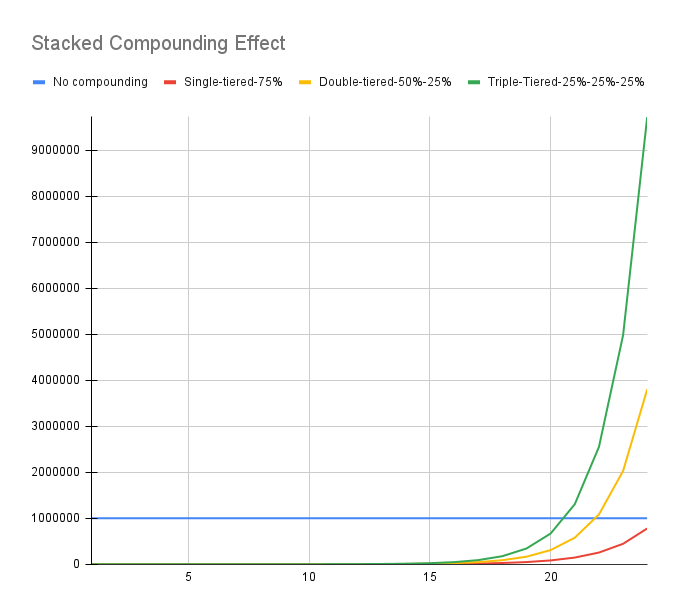
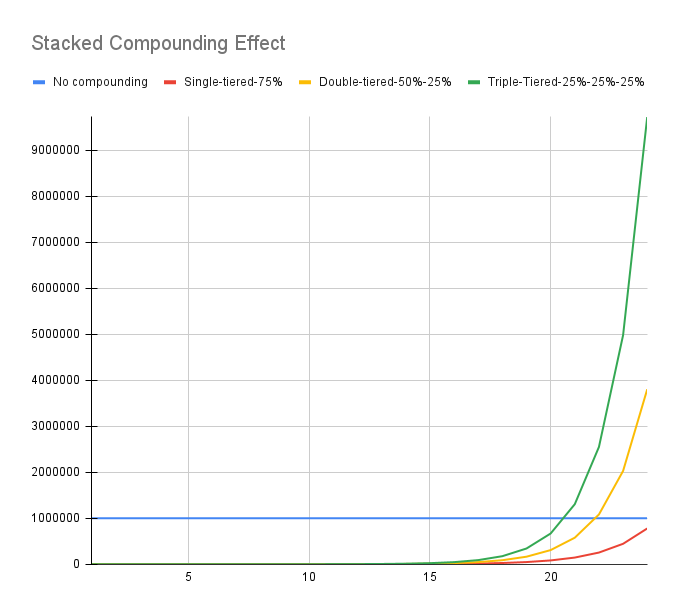
We all understand compounding in theory: reinvesting growth so that it builds upon itself over time. But what if you could compound on top of your compounding—layering growth within the same period? That’s what we call stacked compounding, and it has the power to create truly exponential outcomes. The Visual That Says It All Take a look at the chart above, which compares four growth paths over 24 months: No Compounding (Flat Line) – Value remains stagnant. Single-Tiered Compounding (75%) – Traditional, strong growth. Double-Tiered (50% + 25%) – Two sequential layers of growth. Triple-Tiered (25% + 25% + 25%) – Three layers of growth stacked in a single cycle. Although each compounding path uses the same total growth rate (75%), the outcome is dramatically different. The triple-tiered model outpaces all others—by millions. Why Stacking Beats Simple Compounding Each layer in stacked compounding compounds on an already-increased base: First layer grows the base. Second layer compounds on that. Third layer accelerates even further. The result is compounding over compounding—and it explains why triple-tiered growth shoots upward while traditional growth lags behind. The Patience Factor: When Results Really Start to Show But here’s the catch: stacked compounding doesn’t look impressive at first. For the first 10–12 months, results are modest. Months 15–18 show the first major gains. By months 20–24, the curve explodes—especially in the triple-tiered model. This is what James Clear calls the “Valley of Latent Potential.” Your efforts are working, but the results are still building beneath the surface. If you give up too soon, you miss the magic. Business Takeaway: Stack Everything Stacked compounding isn’t just for investing—it’s a philosophy for business growth: Marketing: Follow an ad with email → retargeting → webinar invite. Sales: Outreach → personalized demo → special offer. Product: Deliver value → educate → upsell. Each touchpoint stacks, amplifying the one before it. Final Word: Stack. Wait. Win. Stacked compounding shows that order matters—and so does patience. The biggest wins don’t come from a single big move. They come from layered, consistent action that builds on itself over time. Don’t just grow. Stack your growth. And give it time.
Stacked Compounding: The Hidden Growth Strategy That Outperforms Everything
What the Persian King Didn’t See Coming — The Power of Exponential Thinking
When the ancient game of chess was invented, the king of Persia (or India, depending on the version) was so impressed that he offered the game’s creator any reward he wished. The inventor’s request seemed modest: “Place one grain of rice on the first square of the chessboard, two on the second, four on the third, and so on—doubling the amount on each of the 64 squares.” The king laughed at the simplicity of the request and granted it immediately. But soon, his court mathematicians realized the true cost: By the 10th square: over 500 grains By the 20th: over 500,000 grains By the 40th: over 550 billion grains By the 64th square: 18.4 quintillion grains of rice That’s more rice than exists on Earth. The king was stunned—and unable to fulfill the promise. The Lesson? Exponential growth always starts quietly—then compounds explosively. In business, we often think linearly: add a client, launch a feature, and fix a workflow. But when systems are designed to scale—when innovation, efficiency, and integration are aligned—the results multiply, not just add. That’s why companies with compounding ecosystems, like ClinicMind, don’t just grow—they accelerate. At ClinicMind, we see this lesson play out across the practices we serve: A provider implements our EHR—they save time. Then they launch Credentialing and PatientHub—their visit volume increases. Then they turn on AI Scribe—their documentation fatigue disappears. Then they add RCM—their cash flow improves. Each solution alone brings value. But together, they create compounding gains across revenue, workflow, and patient retention. Like grains on the chessboard, every new component multiplies the return on the one before it. That’s what makes ClinicMind more than a product. It’s a growth engine—designed to scale with each client’s ambition. Next time you think a small improvement isn’t worth it, remember the chessboard. You might be on square 4 now. But square 64 is coming sooner than you think.
What the Persian King Didn’t See Coming — The Power of Exponential Thinking
Understanding the AMA CPT Code Licensing Fee on Your ClinicMind Invoice
What Are CPT Codes and Why Are They Essential? Current Procedural Terminology (CPT codes), developed and maintained by the American Medical Association (AMA), serve as the standardized system for reporting medical, surgical, and diagnostic procedures. These codes are critical for accurate billing, documentation, and communication between healthcare providers and insurance payers. Why Is There a Licensing Fee for CPT Codes? The AMA owns the copyright to CPT codes, and any EHR, billing system, or practice management platform that integrates them must obtain a license. This ensures: Ongoing maintenance and updates to reflect medical advancements. Compliance with regulatory requirements for accurate coding. Uniformity in medical billing to prevent discrepancies. Any entity that uses, references, or displays CPT content is required to obtain a license from the AMA or an authorized distributor. This includes electronic health record (EHR) systems, practice management software, and other healthcare applications incorporating CPT codes. How Does This Impact ClinicMind Users? ClinicMind integrates CPT codes within its platform to streamline your billing and documentation processes. To comply with AMA licensing requirements, ClinicMind incurs an annual per-provider fee for the use of these codes. Consequently, this cost is reflected in your invoice as the “AMA CPT Code Licensing Fee.” This practice is standard across the industry, as all users of CPT content are expected to obtain the appropriate license for their use case (References below). Starting May 1, ClinicMind invoices will reflect two new AMA CPT licensing fee line items: A one-time charge covering up to three years of past CPT code usage. A monthly charge for the current billing period. Although the AMA charges this fee annually, ClinicMind has structured it into 12 monthly installments for ease of payment. Note: This is a pass-through cost—ClinicMind does not add any markup or service fees on top of the AMA license. Frequently Asked Questions (FAQ) Q1: Do all providers need to pay for CPT code licensing? Yes. Any clinician using CPT codes in their practice—whether for insurance billing, out-of-network claims, or clinical documentation—must have a valid AMA license. Q2: Is this fee unique to ClinicMind? No. All EHR, practice management, and billing platforms that include CPT codes must pay licensingfees to the AMA. Q3: How are licensing royalties determined? The AMA applies royalties for the use of CPT codes based on the type of product in which the CPT content is used and the type of user of the product. Q4: Does this fee apply per practice or per clinician? The AMA fee is typically charged annually per practice type, regardless of the number of clinicians yearly, ensuring each provider has access to an up-to-date, compliant CPT code set. Q5: Can I opt out if I don’t use insurance billing? No. Even if you don’t bill insurance, CPT codes are still required for standardized documentation, out of-network claims, and medical record accuracy. Q6: Will my administrative staff be charged the AMA fee? No, the fee applies only to members of your practice who have a clinician role in ClinicMind. Q7: Can I pay the AMA directly instead of through ClinicMind? While you can purchase a CPT license directly from the AMA, it won’t cover ClinicMind’s use of CPT codes within our EHR. Why This Matters Understanding the AMA CPT licensing fee helps providers ensure compliance, maintain billing accuracy, and contribute to the ongoing development of the healthcare industry’s standard coding system. If you have any questions about how this applies to your ClinicMind account, please reach out to our support team. Summary of Key Points: CPT codes are AMA-owned and require a paid license for use in EHRs. ClinicMind, like other platforms, must pass this cost through to providers. The AMA charges annually, but ClinicMind offers monthly payments. This fee applies per clinician and is a mandatory compliance cost. No service fees or markups are added—ClinicMind only passes the direct AMA cost. By structuring the AMA CPT licensing fee transparently and fairly, ClinicMind ensures that our users stay compliant without unnecessary financial burden. References 1. simplepractice.com AMA fee FAQs https://support.simplepractice.com/hc/en-us/articles/28804985196173-AMA-fee-FAQs 2.Therapybrands.com FAQ Regarding Recent CPT Code Licensing Fees (Fusion Enterprise) https://support.therapybrands.com/s/article/4409539675028-FAQ-Regarding-Recent-CPT-Code-Licensing-Fees-Fusion-Enterprise 3.Practicefusion.com CPT License FAQ https://help.practicefusion.com/s/article/CPT-License-FAQ 4.en.wikipedia.org Current Procedural Terminology April 10, 2024 — The Current Procedural Terminology (CPT) code set is a procedural code set developed by the American Medical Association (AMA). It is maintained by the CPT Editorial Panel. The CPT code set describes… 5.ama-assn.org Licensing CPT for AI FAQs – American Medical Association March 6, 2025 — Find out the answers to frequently asked questions about licensing CPT for augmented intelligence (AI). 6.ama-assn.org CPT® licensing frequently asked questions (FAQs) October 10, 2024 — Any entity using CPT content anywhere worldwide must have a license authorizing the use of CPT code set from the AMA or an authorized distributor. 7.AMA Compliance Internal End User License Agreement Royalty Rates for 2025, 2026 … July 22, 2024 — A minimum royalty of $100.00 applies for each annual release of the CPT Standard Data File in Covered Products licensed under the Health Plan Model. 8.AMA Compliance Notice: Standard CPT Distribution Pricing Schedule 2024 June 20, 2024 — AMA’s Version of Healthcare Common Procedure Coding System, Level II ; January 1, 2024 ; $19.00 for each User. 9.ama-assn.org CPT® Royalties & Licenses – American Medical Association CPT royalties and licensing ensure you are compliant with the correct uses of CPT code data. Get the latest on CPT codes from the AMA. 10.ama-assn.org CPT® Codes – American Medical Association Here you’ll find the AMA’s latest updates on new CPT codes, code proposals and revisions, CPT code reimbursement and more. 11.ama-assn.org [PDF] CPT Licensing Categories for Licensees Imposing Fees on Physicians WHEREAS, The AMA owns intellectual rights to the CPT code and is legally authorized to. 8 charge just and fair fees for the use of its intellectual property; … 12.ama-assn.org FAQ: Editorial Panel & CPT® overview – American Medical Association For information on the license process, proper use, fees and applications, please visit our licensing page.
