
Credentialed… Now What?
Why Ongoing Credentialing Support Is Critical for Your Practice’s Success Getting credentialed with insurance payers is a major milestone—but it’s not the end of the road. Credentialing isn’t a “set it and forget it” task; it’s an ongoing process that requires regular maintenance to avoid coverage gaps, compliance issues, and revenue loss. That’s why it pays to have a partner like CredEdge by ClinicMind on your side even after your initial credentialing is complete. Staying Credentialed Means Staying Covered Credentialing maintenance ensures you remain in-network with payers without interruptions. Missing a recredentialing deadline, failing to update required documents, or overlooking a contract expiration can result in lost revenue and major headaches. CredEdge keeps you ahead of every deadline with transparent, proactive, and stress-free maintenance services—so you can focus on running your practice without worrying about administrative surprises. The Hidden Risks of Neglecting Credentialing Maintenance Once you’re credentialed, ongoing support becomes critical for a few reasons: Contract and Fee Schedule Changes: Payer contracts are living documents. Without regular checks, you might miss important changes that affect your reimbursement rates. Recredentialing Deadlines: Most payers require recredentialing every 2–3 years. Missing deadlines can cause you to be removed from networks temporarily—or permanently. Provider Updates: Adding new providers or making changes to your practice information must be handled properly to maintain compliance. Data Management: Insurance companies regularly update verification requirements (like CAQH profiles). Staying current ensures you avoid lapses in network status. Without a team actively managing these moving parts, even established practices can face unnecessary disruptions. Why Maintain Your CredEdge Account? With CredEdge, you’re not just “credentialed”—you’re continuously protected and optimized: Flat-Rate Pricing & Unlimited Payers: Add new payers anytime without renegotiating fees. Simple, predictable pricing based on your NPI and practice. Dedicated Credentialing Experts: Meet with your credentialing team every two weeks on Zoom for updates, planning, and support. Proactive Recertification Reminders: Never miss an important document or deadline. We track everything and remind you months in advance. Payer Contract Health Checks: Regular reviews of contract dates, fee schedules, and payer behavior help prevent costly revenue issues. Full Transparency: Access real-time updates, status tracking, and credentialing history through our easy-to-use portal. Seamless Compliance and Verification: We update your CAQH profile every three months and ensure all verifications are continuously in place for in-network status. More Than Just Credentialing—We Manage the Whole Process Credentialing touches every part of your practice’s operations. That’s why CredEdge provides: Linking providers to the correct groups and facilities Workflow automation and database management Contract and facility management Verification and document management Committee reviews and e-documentation Whether you’re a brand-new practice or a growing multi-provider group, having expert ongoing credentialing support is essential for scaling successfully. Don’t risk unnecessary disruptions. Stay credentialed, stay compliant, and stay focused on patient care—with CredEdge by your side. Learn more about CredEdge’s Ongoing Credentialing Support or call (234) 254-2255 to get started today! Take the hassel out of credentialing off your plate! Book a consultation to learn more Book a Consultation
From Chaos to Calm: How AI Can Take Pressure Off Your Front Desk
The Problem: Your Team Is Drowning in Busywork If you run a small practice, you already know that your front desk is often stretched thin. Between phone calls, handling schedules, and following up with no-shows, your team is doing their best—but there’s only so much time in a day. And the result? Frustrated staff. Missed calls. Rushed patient experiences. Sometimes, patients don’t come back. You don’t need more people. You need a smarter way to support the people you already have. Studies show that front desk teams spend up to 30% of their time on phone-related tasks. That’s a third of the day pulled away from patient care. The Guide: Meet PatientHub’s AI Assistant This isn’t just another scheduling tool. PatientHub’s AI bot was built to reduce manual work while improving the way your practice connects with patients. It works in the background—quietly and efficiently—so your staff can stay focused on in-person care. The Plan: 4 Ways PatientHub’s AI Bot Saves Time 1. Schedules Appointments Automatically The AI assistant helps patients book, cancel, or reschedule appointments 24/7—no phone tag, no double bookings, and fewer no-shows. Available after hours, during lunch breaks, and on weekends Patients handle scheduling themselves Your staff stays focused on patients in front of them 2. Answers Common Questions Instantly Patients often call with quick questions: “Are you open on weekends?” “Do you accept my insurance?” “What should I bring on my first visit?” Instead of tying up your team, the AI bot provides fast, accurate answers—anytime, even at 2 a.m. Reduces phone volume Keeps your staff on task Boosts patient satisfaction 3. Follows Up Without You Lifting a Finger Life gets busy—patients forget appointments or delay rebooking. The bot sends thoughtful, timely follow-ups that keep your calendar full. Personalized messages that feel human, not robotic Helps patients re-engage Fewer missed visits, better retention You don’t have to chase patients anymore. The bot does the follow-up so your team doesn’t have to. 4. Responds to Reviews Automatically When patients leave a review, they want to be heard. But managing reviews takes time. The AI bot responds professionally and promptly—while flagging any that need a personal touch. Protects your online reputation Builds trust with new patients Saves hours every month The Value: More Time, Less Stress, Better Experience Practices using PatientHub’s AI bot save up to 10–20 hours per week. But the real value isn’t just time—it’s how your day flows. More time for face-to-face patient care Fewer distractions for your team A smoother, more professional experience for every patient Less burnout. More impact. This isn’t just automation—it’s peace of mind. The Bigger Picture: What PatientHub Is Really About PatientHub was built for small practices that do a lot with very little. We understand the reality of running a clinic where every call, every task, and every interaction matters. Our mission is simple: Support your team without sacrificing the human touch. We help you: Attract and retain patients Streamline communication Reduce no-shows Keep your staff focused, not frazzled You don’t need more apps or more admin—you need tools that actually reduce the load. That’s what we build. The Solution: Let Your Team Breathe Again If your front desk is overwhelmed, you’re not alone. Most small practices are feeling the same pressure. With PatientHub’s AI assistant, you can finally give your team space to breathe, reset, and work the way they want to—without adding more to their plate. Want to see how it works? Book a FREE demo here and we’ll walk you through it. The Team Behind the Tool PatientHub is just one of the many ways ClinicMind supports healthcare providers. As a company, ClinicMind is committed to helping clinics work smarter, not harder—through technology that enhances care without adding complexity. “Absolutely thrilled with Clinicmind and the incredible support from the team. Clinicmind all in all is incredibly intuitive, user-friendly and has streamlined our practice’s workflow in ways we couldn’t have imagined. The Team’s dedication to helping us succeed was clear, and we appreciate how they tailored everything to our specific needs. Highly recommend it!”Tanin Khademi, D.C.Los Angeles, CA Whether it’s automating daily tasks or optimizing practice workflows, everything ClinicMind builds is designed with one goal in mind: to empower teams to do more of what matters. You don’t just have to take our word for it—ClinicMind was recently named a G2 Momentum Leader in Medical Billing, recognized for delivering both innovation and real results to healthcare practices like yours. See the Calm After the Chaos Book your free demo today. Let us show you how one AI assistant can transform your front desk—from overwhelmed to organized, from burnout to balance. Interesting Reads: Learn how Patient Loyalty Drives GrowthTransform Your Chiropractic Practice with AI
You Did It Again: ClinicMind Named G2 Momentum Leader in Medical Billing
You Did It Again: ClinicMind Named G2 Momentum Leader in Medical Billing Let’s talk about momentum. Not the kind you read about in physics class, but the kind that happens when a clinic finds its rhythm, scales its systems, and grows on repeat. Thanks to your trust, your reviews, and your daily hustle, ClinicMind has just been named the G2 Momentum Leader in Medical Billing for Spring 2025. And yes, the award is exciting. But just like always, it’s not about us—it’s about you. Recognition That Reflects Your Progress This latest G2 award is more than a badge. It’s a reflection of every provider who’s decided to take control of their revenue cycle without drowning in complexity. Here’s what this momentum means in real terms: ✅ Faster, more predictable billing✅ Reduced administrative headaches✅ Streamlined patient journeys—from scheduling to payment✅ And more time to do what matters most: care for patients As Reuven shared in his video, this recognition is powered by your authentic feedback—real reviews from real healthcare professionals who use ClinicMind every day to move their clinics forward. “Our mission has always been to empower providers with intuitive solutions that reduce burdens and improve care. This award proves we’re doing just that.” — Reuven Lirov, Chief Operations Officer of ClinicMind One Platform. Endless Possibilities. ClinicMind 2.0 wasn’t built to win awards. It was built to make your clinic run better, faster, and smarter. From patient acquisition and EHR to billing, credentialing, and automation—you’ve got everything under one roof. No more switching tools or juggling vendors. Just one streamlined platform built for growth. The Compounding Growth Effect Is Real This G2 Momentum Award joins a long list of ClinicMind recognitions—11 consecutive quarters of G2 leadership, to be exact. But it’s not just a streak. It’s a sign of compounding success. Because when you layer small, smart improvements—like better retention, stronger billing, and smoother operations—the result isn’t linear. It’s exponential. What’s Next? Your Dream Practice. If you’re tired of chaos and ready for clarity, we’re here to help you build your dream practice. 🎯 Schedule a Free Practice Growth Analysis 📖 Read The Press Release Here 💡 Learn What ClinicMind 2.0 Can Do for You Let’s keep the momentum going because this is only the beginning.
8 G2 Awards and What They Say About You
Let’s be honest: winning awards is great. But at ClinicMind, we see it differently. When we earned 8 G2 Spring 2025 Awards including Leader in Chiropractic and High Performer in EHR and Medical Billing—it wasn’t just about us. It was about you. Because every badge, every leadership ranking, and every glowing review from G2 comes from one source: the clinics that are doing the work, showing up for patients, and growing their businesses with ClinicMind as their partner. This recognition belongs to you, the hero of this story. Your Growth Is the Real Story We didn’t set out to win awards. We set out to build tools that help real people, like you, grow their practices without drowning in disconnected systems or back-office chaos. These G2 awards? They tell us we’re on the right track. You’re managing Chiropractic clinics more efficiently. You’re navigating EHR and documentation with less friction. You’re seeing faster, more reliable billing results. You’re growing—quarter after quarter. And the fact that we’ve now hit 11 consecutive quarters of G2 leadership? That’s just more proof that when you succeed, we all move forward together. You’ve Built Smarter Workflows. We Just Helped. The clinics that thrive with ClinicMind aren’t looking for bells and whistles. They’re looking for: Simplified scheduling Faster revenue cycles Stronger patient retention Credentialing that doesn’t require a second career You built those systems. You embraced automation. You reimagined how your practice operates. ClinicMind 2.0 simply gave you the engine to do it faster and smarter. One Platform. One Team. One Vision. No more patchwork tech stacks. No more calling three vendors to fix one issue. ClinicMind’s all-in-one platform means you have: A single point of contact A seamless user experience A unified team that actually understands your clinic This is why practices using ClinicMind see what we call the Compounding Growth Effect: small, consistent improvements across patient acquisition, operations, and revenue that multiply over time into exponential growth. Awards Come and Go. Impact Stays. These G2 awards are a reflection of something deeper than software—they’re a reflection of your resilience, your progress, and your vision for what your clinic could become. “When our clients grow, we grow with them.” — Dr. Brian Capra, DC, President of ClinicMind So, to every ClinicMind user who left a review, shared their experience, or just kept showing up for their community, you’re the reason we’re here. Ready to Write Your Own Growth Story? If you’re building a clinic that’s ready to scale without the stress, we’d love to be part of that journey. 👉 Get a Free Practice Growth Consultation 👉 Read The Press Release Here 👉 Learn What ClinicMind 2.0 Can Do for You P.S. The G2 badges look great. But they’re nothing compared to the real reward: seeing your clinic thrive.
Scaling a Healthcare Practice Does Not Have to be Difficult
Most providers eventually hit a growth ceiling but not always for the reasons you’d expect. Some struggle to bring in enough patients. Others have the volume but can’t scale because of inefficient systems, disconnected tools, and administrative overload. Either way, growth becomes harder than it should be—and the passion that launched the practice starts to fade under daily pressure. At ClinicMind, we’ve worked with thousands of practices. And we’ve seen how growth stalls when tools can’t keep up with ambition. What’s Really Holding Practices Back Sometimes, it’s patient flow.Sometimes it’s internal chaos.But most often, it’s a combination of both. One system for scheduling Another – for documentation A separate billing solution Yet another – for patient communication or credentialing Each tool works in isolation—but they don’t work well enough together. Time is lost in handoffs, data is duplicated, and support becomes a maze. And when you’re trying to grow, those cracks widen fast. ClinicMind EHR 2.0: Designed to Grow with You ClinicMind 2.0 isn’t just a fresh interface. It’s part of an integrated platform built for real, sustainable growth—whether you’re trying to attract more patients, open a second location, or improve cash flow without adding more staff. How EHR 2.0 Powers Practice Growth ClinicMind EHR 2.0 is more than just a UI update—it’s a catalyst for growth across every part of your practice. Yes, it’s faster. Yes, it’s easier to use. But what truly sets it apart is how it connects seamlessly with the rest of ClinicMind’s integrated platform to unlock your practice’s full potential. From attracting new patients to retaining loyal ones, from reducing admin time to increasing revenue per visit, ClinicMind 2.0 supports growth at every level: Attract More Patients: With PatientHub, your EHR becomes a growth engine. It automates marketing, manages online reviews, and follows up with prospects—so your schedule stays full without your team having to chase leads manually. Convert and Retain More Patients: A cleaner, more intuitive interface improves the patient experience and reduces time spent on documentation. That means more face time with patients, better communication, and a practice environment patients want to return to—and recommend. Streamline Workflow and Reduce Overhead: Integrated tools mean fewer clicks, fewer errors, and less switching between platforms. Staff productivity improves, training time drops, and team burnout decreases—all without adding new headcount. Improve Financial Performance: Claims360 uses AI to reduce denials and accelerate reimbursement timelines. Plus, with better credentialing via CredEdge, you expand your payer access and get paid for more of the care you already provide. When these systems work in harmony, the results don’t just add up—they compound. ClinicMind 2.0 isn’t just easier to use—it’s built to support scalable growth. As your patient volume increases, the system keeps pace without adding operational friction, so your team can stay focused on delivering exceptional care. Upgrade at Your Own Pace with Dual-Mode Functionality ClinicMind 2.0 introduces a unique dual-interface capability, letting your team toggle between the classic and updated UI—module by module, at your own pace. That means: No retraining everyone at once No loss of work or context mid-transition No disruption to patient care Built from Real Provider Feedback Every feature in ClinicMind EHR 2.0 was shaped by what providers told us they needed most: Cleaner navigation that saves time on every task Shorter onboarding time for new staff Workflows that make sense for real clinical teams This next-generation experience was designed not just to support your current operations, but to grow with you as your goals evolve. Whether You’re Stuck or Scaling—We’ve Got You Some practices are just trying to survive. Others are preparing to expand. ClinicMind EHR 2.0 supports both, giving you a growth-ready system with the flexibility to meet your current needs—and the power to grow when you’re ready. You shouldn’t have to choose between stability and progress. With ClinicMind, you don’t have to. Want to See It in Action? ClinicMind EHR 2.0 is available now as part of our latest release. Let us show you what scalable, integrated practice growth really looks like. 👉 Schedule a personalized demo
Stacked Compounding: The Hidden Growth Strategy That Outperforms Everything
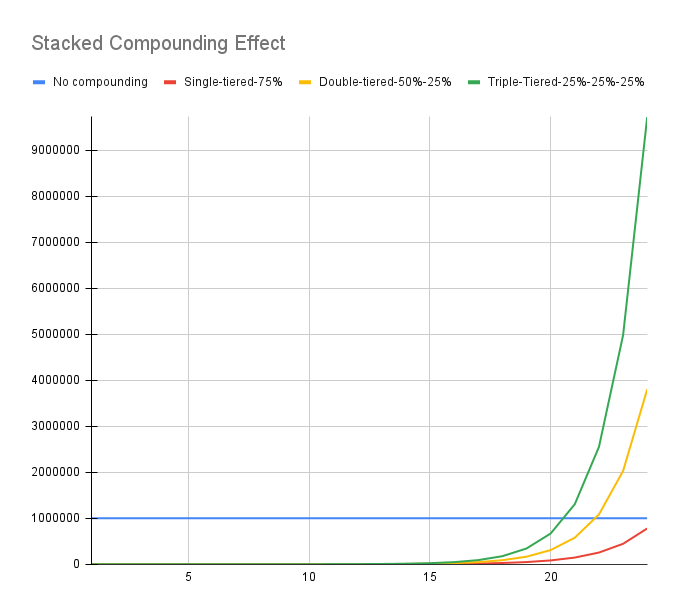
We all understand compounding in theory: reinvesting growth so that it builds upon itself over time. But what if you could compound on top of your compounding—layering growth within the same period? That’s what we call stacked compounding, and it has the power to create truly exponential outcomes. The Visual That Says It All Take a look at the chart above, which compares four growth paths over 24 months: No Compounding (Flat Line) – Value remains stagnant. Single-Tiered Compounding (75%) – Traditional, strong growth. Double-Tiered (50% + 25%) – Two sequential layers of growth. Triple-Tiered (25% + 25% + 25%) – Three layers of growth stacked in a single cycle. Although each compounding path uses the same total growth rate (75%), the outcome is dramatically different. The triple-tiered model outpaces all others—by millions. Why Stacking Beats Simple Compounding Each layer in stacked compounding compounds on an already-increased base: First layer grows the base. Second layer compounds on that. Third layer accelerates even further. The result is compounding over compounding—and it explains why triple-tiered growth shoots upward while traditional growth lags behind. The Patience Factor: When Results Really Start to Show But here’s the catch: stacked compounding doesn’t look impressive at first. For the first 10–12 months, results are modest. Months 15–18 show the first major gains. By months 20–24, the curve explodes—especially in the triple-tiered model. This is what James Clear calls the “Valley of Latent Potential.” Your efforts are working, but the results are still building beneath the surface. If you give up too soon, you miss the magic. Business Takeaway: Stack Everything Stacked compounding isn’t just for investing—it’s a philosophy for business growth: Marketing: Follow an ad with email → retargeting → webinar invite. Sales: Outreach → personalized demo → special offer. Product: Deliver value → educate → upsell. Each touchpoint stacks, amplifying the one before it. Final Word: Stack. Wait. Win. Stacked compounding shows that order matters—and so does patience. The biggest wins don’t come from a single big move. They come from layered, consistent action that builds on itself over time. Don’t just grow. Stack your growth. And give it time.
What the Persian King Didn’t See Coming — The Power of Exponential Thinking
When the ancient game of chess was invented, the king of Persia (or India, depending on the version) was so impressed that he offered the game’s creator any reward he wished. The inventor’s request seemed modest: “Place one grain of rice on the first square of the chessboard, two on the second, four on the third, and so on—doubling the amount on each of the 64 squares.” The king laughed at the simplicity of the request and granted it immediately. But soon, his court mathematicians realized the true cost: By the 10th square: over 500 grains By the 20th: over 500,000 grains By the 40th: over 550 billion grains By the 64th square: 18.4 quintillion grains of rice That’s more rice than exists on Earth. The king was stunned—and unable to fulfill the promise. The Lesson? Exponential growth always starts quietly—then compounds explosively. In business, we often think linearly: add a client, launch a feature, and fix a workflow. But when systems are designed to scale—when innovation, efficiency, and integration are aligned—the results multiply, not just add. That’s why companies with compounding ecosystems, like ClinicMind, don’t just grow—they accelerate. At ClinicMind, we see this lesson play out across the practices we serve: A provider implements our EHR—they save time. Then they launch Credentialing and PatientHub—their visit volume increases. Then they turn on AI Scribe—their documentation fatigue disappears. Then they add RCM—their cash flow improves. Each solution alone brings value. But together, they create compounding gains across revenue, workflow, and patient retention. Like grains on the chessboard, every new component multiplies the return on the one before it. That’s what makes ClinicMind more than a product. It’s a growth engine—designed to scale with each client’s ambition. Next time you think a small improvement isn’t worth it, remember the chessboard. You might be on square 4 now. But square 64 is coming sooner than you think.
Understanding the AMA CPT Code Licensing Fee on Your ClinicMind Invoice
What Are CPT Codes and Why Are They Essential? Current Procedural Terminology (CPT codes), developed and maintained by the American Medical Association (AMA), serve as the standardized system for reporting medical, surgical, and diagnostic procedures. These codes are critical for accurate billing, documentation, and communication between healthcare providers and insurance payers. Why Is There a Licensing Fee for CPT Codes? The AMA owns the copyright to CPT codes, and any EHR, billing system, or practice management platform that integrates them must obtain a license. This ensures: Ongoing maintenance and updates to reflect medical advancements. Compliance with regulatory requirements for accurate coding. Uniformity in medical billing to prevent discrepancies. Any entity that uses, references, or displays CPT content is required to obtain a license from the AMA or an authorized distributor. This includes electronic health record (EHR) systems, practice management software, and other healthcare applications incorporating CPT codes. How Does This Impact ClinicMind Users? ClinicMind integrates CPT codes within its platform to streamline your billing and documentation processes. To comply with AMA licensing requirements, ClinicMind incurs an annual per-provider fee for the use of these codes. Consequently, this cost is reflected in your invoice as the “AMA CPT Code Licensing Fee.” This practice is standard across the industry, as all users of CPT content are expected to obtain the appropriate license for their use case (References below). Starting May 1, ClinicMind invoices will reflect two new AMA CPT licensing fee line items: A one-time charge covering up to three years of past CPT code usage. A monthly charge for the current billing period. Although the AMA charges this fee annually, ClinicMind has structured it into 12 monthly installments for ease of payment. Note: This is a pass-through cost—ClinicMind does not add any markup or service fees on top of the AMA license. Frequently Asked Questions (FAQ) Q1: Do all providers need to pay for CPT code licensing? Yes. Any clinician using CPT codes in their practice—whether for insurance billing, out-of-network claims, or clinical documentation—must have a valid AMA license. Q2: Is this fee unique to ClinicMind? No. All EHR, practice management, and billing platforms that include CPT codes must pay licensingfees to the AMA. Q3: How are licensing royalties determined? The AMA applies royalties for the use of CPT codes based on the type of product in which the CPT content is used and the type of user of the product. Q4: Does this fee apply per practice or per clinician? The AMA fee is typically charged annually per practice type, regardless of the number of clinicians yearly, ensuring each provider has access to an up-to-date, compliant CPT code set. Q5: Can I opt out if I don’t use insurance billing? No. Even if you don’t bill insurance, CPT codes are still required for standardized documentation, out of-network claims, and medical record accuracy. Q6: Will my administrative staff be charged the AMA fee? No, the fee applies only to members of your practice who have a clinician role in ClinicMind. Q7: Can I pay the AMA directly instead of through ClinicMind? While you can purchase a CPT license directly from the AMA, it won’t cover ClinicMind’s use of CPT codes within our EHR. Why This Matters Understanding the AMA CPT licensing fee helps providers ensure compliance, maintain billing accuracy, and contribute to the ongoing development of the healthcare industry’s standard coding system. If you have any questions about how this applies to your ClinicMind account, please reach out to our support team. Summary of Key Points: CPT codes are AMA-owned and require a paid license for use in EHRs. ClinicMind, like other platforms, must pass this cost through to providers. The AMA charges annually, but ClinicMind offers monthly payments. This fee applies per clinician and is a mandatory compliance cost. No service fees or markups are added—ClinicMind only passes the direct AMA cost. By structuring the AMA CPT licensing fee transparently and fairly, ClinicMind ensures that our users stay compliant without unnecessary financial burden. References 1. simplepractice.com AMA fee FAQs https://support.simplepractice.com/hc/en-us/articles/28804985196173-AMA-fee-FAQs 2.Therapybrands.com FAQ Regarding Recent CPT Code Licensing Fees (Fusion Enterprise) https://support.therapybrands.com/s/article/4409539675028-FAQ-Regarding-Recent-CPT-Code-Licensing-Fees-Fusion-Enterprise 3.Practicefusion.com CPT License FAQ https://help.practicefusion.com/s/article/CPT-License-FAQ 4.en.wikipedia.org Current Procedural Terminology April 10, 2024 — The Current Procedural Terminology (CPT) code set is a procedural code set developed by the American Medical Association (AMA). It is maintained by the CPT Editorial Panel. The CPT code set describes… 5.ama-assn.org Licensing CPT for AI FAQs – American Medical Association March 6, 2025 — Find out the answers to frequently asked questions about licensing CPT for augmented intelligence (AI). 6.ama-assn.org CPT® licensing frequently asked questions (FAQs) October 10, 2024 — Any entity using CPT content anywhere worldwide must have a license authorizing the use of CPT code set from the AMA or an authorized distributor. 7.AMA Compliance Internal End User License Agreement Royalty Rates for 2025, 2026 … July 22, 2024 — A minimum royalty of $100.00 applies for each annual release of the CPT Standard Data File in Covered Products licensed under the Health Plan Model. 8.AMA Compliance Notice: Standard CPT Distribution Pricing Schedule 2024 June 20, 2024 — AMA’s Version of Healthcare Common Procedure Coding System, Level II ; January 1, 2024 ; $19.00 for each User. 9.ama-assn.org CPT® Royalties & Licenses – American Medical Association CPT royalties and licensing ensure you are compliant with the correct uses of CPT code data. Get the latest on CPT codes from the AMA. 10.ama-assn.org CPT® Codes – American Medical Association Here you’ll find the AMA’s latest updates on new CPT codes, code proposals and revisions, CPT code reimbursement and more. 11.ama-assn.org [PDF] CPT Licensing Categories for Licensees Imposing Fees on Physicians WHEREAS, The AMA owns intellectual rights to the CPT code and is legally authorized to. 8 charge just and fair fees for the use of its intellectual property; … 12.ama-assn.org FAQ: Editorial Panel & CPT® overview – American Medical Association For information on the license process, proper use, fees and applications, please visit our licensing page.
Chiropractic Credentialing Checklist: A Step-by-Step Guide
Credentialing is a critical process for chiropractors looking to accept insurance and expand their patient base. Without proper credentialing, chiropractors risk delays in reimbursement or outright claim denials. Whether you’re a new chiropractor or updating your credentials, following a structured checklist can help ensure a smooth process. Why Credentialing Matters for Chiropractors Credentialing verifies your qualifications and allows you to bill insurance companies for your services. It’s different from payer enrollment, which is the process of getting linked to specific insurance networks. (For more on this distinction, check out How Is Insurance Payer Enrollment Different From Credentialing for Chiropractors?) Proper credentialing also helps avoid common issues like network rejections, which can occur if your paperwork is incomplete or outdated (5 Reasons Chiropractors Can Be Rejected by Insurance Company Networks During the Credentialing Process). The Chiropractic Credentialing Checklist 1. Gather Essential Documents State Chiropractic License (must be current and in good standing) National Provider Identifier (NPI) Malpractice Insurance Certificate Chiropractic School Diploma Continuing Education Credits (if applicable) Tax Identification Number (TIN) or Employer Identification Number (EIN) 2. Get Your CAQH Profile in Order Most insurance companies use the Council for Affordable Quality Healthcare (CAQH) for credentialing verification. Ensure your CAQH profile is: ✅ Updated with the latest practice information ✅ Complete with all required documentation ✅ Re-attested every 120 days to stay active Learn more about why credentialing in medical billing systems matters: Credentialing in Medical Billing Systems. 3. Apply to Insurance Networks Once you’ve completed your CAQH profile, you’ll need to apply to individual insurance companies and government payers like Medicare and Medicaid (Medicare and Medicaid Credentialing). Each payer has its own credentialing process and timelines, so be prepared for some variability. 4. Follow Up on Your Applications Most insurance companies take 60-120 days to process credentialing applications. Contact payers regularly to check your application status. Be prepared to submit additional documentation or clarifications if needed. Want to streamline your applications? Read 6 Steps to Credentialing with Insurance Companies for Chiropractors. 5. Get Linked to Your Practice Credentialing isn’t just about getting approved—it’s about ensuring you are properly linked to your practice so that your reimbursement claims aren’t denied. This is a common mistake that can lead to months of lost revenue if not handled correctly. For more details on potential pitfalls, check out Traversing the Credentialing Maze. 6. Maintain and Renew Your Credentials Credentialing isn’t a one-time process. Insurance companies require ongoing verification, including: License renewals Malpractice insurance updates CAQH re-attestation Keeping your practice details up to date Staying on top of renewals ensures staff efficiency and fewer reimbursement delays (The Impact of Credentialing on Staff Efficiency). Make Chiropractic Credentialing Hassle-Free with CredEdge Credentialing can be time-consuming and complicated, but CredEdge by ClinicMind simplifies the process. We handle everything from initial credentialing to ongoing renewals, document management, and payer follow-ups—so you can focus on patient care instead of paperwork. ✅ Flat-rate pricing—no hidden fees ✅ Full credentialing lifecycle management ✅ Stay linked, updated, and always in good standing Don’t let credentialing delays impact your practice. Get started with CredEdge today. Take the hassel out of credentialing off your plate! Book a consultation to learn more Book a Consultation
Finding Purpose in Private Practice: A Four-Part Exploration – (Part 1: Uncovering the Role of Purpose and Mission)
Introduction In healthcare, success often gets measured by external markers: the number of patients seen, the caliber of equipment purchased, or the efficiency of billing systems. While these are important, focusing on them in isolation can lead to a nagging sense that something more fundamental is missing. This something—often described as purpose or mission—is what unifies all those daily decisions into a coherent, meaningful path (Collins & Porras, 1994; Sinek, 2009). In this first post, we’ll unpack why purpose and mission are crucial in private practice. We’ll also introduce you to Joseph and Bonnie, two physical therapy clinic owners facing a crisis that can teach us a lot about how quickly things unravel when purpose drifts out of sight. 1. More Than a Collection of “Right” Decisions Healthcare professionals pride themselves on making “right” decisions: Hiring the right people and firing those who prove to be a poor fit Investing in top-tier equipment for diagnostics or therapy Seeking expert consultants to streamline operations Emphasizing personal well-being with exercise, nutrition, and adequate rest All of these actions are vital. However, purpose (or “mission” in a business context) weaves these separate initiatives into a bigger picture that resonates with patients, staff, and owners alike (Osterwalder & Pigneur, 2010). Without a unifying purpose, each “right” decision stands alone—like puzzle pieces without a completed image to guide you. Healthcare’s Missing Word In business, it’s “mission statement.” In personal development, it’s “purpose” or “calling.” In healthcare, we often assume our altruistic drive to help patients is enough. But a clearly articulated purpose transcends assumptions, serving as a daily reminder of why we do what we do (Schwartz, Simon, & Bessen, 2018). 2. Purpose as the “Hidden Substance” The text draws a parallel between “empty space” and purpose. Even when things appear empty, something profound exists beneath the surface. In healthcare, this intangible element is your guiding mission—the principle that tells you and your team, “This is why we opened our doors; this is what makes every patient interaction matter” (Kotter, 2012). Patient Engagement: When you say to a patient, “We’re on a mission together,” you invite them into a collaborative relationship, boosting compliance and trust. Team Cohesion: A mission grounds staff members, offering them a sense of belonging and direction (DeCelles, 2020). 3. Introducing Joseph and Bonnie Joseph and Bonnie own a physical therapy clinic in Utah. Their once-thriving practice now struggles under financial strain and personal stress. They’ve let their health slip, gained weight, and even their children are showing signs of distress. Despite being clinically competent, they’ve lost the spark that made their work meaningful. Why Their Story Matters Real-Life Consequences: It’s not just about losing money—patients suffer, staff morale dips, and personal relationships fray. Relatable Crisis: Many healthcare professionals eventually face a moment where their why feels blurred, replaced by endless to-do lists. Conclusion Healthcare practice ownership involves countless “right” decisions, but those choices need a compass to ensure they lead somewhere fulfilling. Purpose acts as that compass, anchoring each decision to a larger mission that resonates on both professional and personal levels (Sinek, 2009). In the next part, we’ll delve deeper into Joseph and Bonnie’s story, illustrating what happens when survival mode replaces purposeful practice.
