
Control Claim Flow Visually Using Radar Software
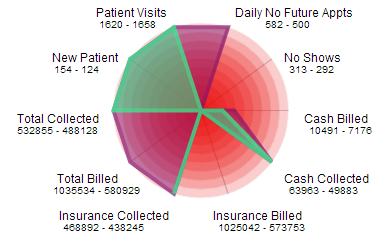
Do you worry about insurance claims payment delays? Peace of mind is hard to come by when you don’t have control over your chiropractic claims process since this affects your practice cash flow negatively. If you cannot track and predict your cash flow easily your business is doomed to die. To make matters worse, you drive away patients when you are stressed out, which further hinders the growth of your chiropractic clinic. Ultimately, you cannot achieve any long-term profitability without sufficient growth. Since seeing patients is your priority, you can’t make time to micromanage each chiropractic billing aspect. Addressing the large amount of failing or rejected claims is virtually impossible with limited resources. Nevertheless, you need to follow up on your chiropractic claims to avoid reduced cash flow for your practice. Inconsistent and ineffective chiropractic billing performance can have many culprits including incompetent or untrained staff. But no one can adequately keep track and follow up on all underpaid and denied claims without effective chiropractic software. However, not correcting these claims can affect the entire practice negatively since they will be forgotten and as such increase the percentage of your AR past 120 days. In fact, you need to track your active claims backlog in order to evaluate your chiropractic billing performance and AR. Managing a chiropractic office is a balancing act of multiple Key Performance Indicators (KPIs), though. It can be challenging to prioritize tasks as many chiropractors tackle easy problems first before they focus on more important matters. Instead of just putting out random fires you need to see the big picture consistently if you want to improve your claims workflow management and chiropractic billing performance. In order to do that you need a centralized organization of tasks and performance. Hence, it is vital to choose the right chiropractic software functionality. Naturally, your practice has a unique workflow that can only be supported by configurable and customizable chiropractic software. Yet, learning new chiropractic software can be a hassle many chiropractors would rather avoid. For that reason you should focus on ease of use for workflow management when evaluating possible chiropractic software solutions for your office. Moreover, all data should be displayed in an easy to digest way so you can complete a meaningful analysis on your own without wading through long and boring text reports. You should be able to look at multiple aspects of your practice at once, just like the snapshot Genesis’ Practice Health Monitor (a.k.a Radar) provides. To improve teamwork every member of your staff can also see this Radar chart on Genesis’ Home page every time they log on. You don’t need to waste time on compiling your practice stats, including claims status since data collection is automated. Furthermore, you and your staff can monitor trends to detect any problem areas before they cripple your practice performance. In order to track your practice performance over time and measure any improvements, you only need to customize your workflow KPIs. Genesis’ daily radar analysis and consistent follow ups in form of monthly Health Checks with your Coach further provide support to help you reach your goals.
Reduce task completion anxiety at your clinic with ticket macros
Are you worried that some of your staff members might forget to complete any of the mandatory 10 tasks for each new patient visiting your chiropractic clinic on any given day? With approximately 300 weekly new-patient-tasks to be accomplished, chiropractors can gain peace of mind by using ticket macros that assign certain tickets to the appropriate staff members for improved workflow and accountability within the clinic. In that way, ticket macros can help ensure that every new-patient-task gets completed in a timely manner for compliance, maximum profitability, optimum patient flow and consistent practice growth. On the other side of the coin, any missed steps/tasks, such as forgetting to ask for the patient’s credit card or not scheduling the next appointment can result in loss of income and reduced patient flow. This often happens when chiropractors have to rely on their staff members’ memory and diligence instead of using a system for effective teamwork. Ultimately, task coordination, transparency, and accountability are the only way to avoid loss of control and loss of predictability, especially when training new staff members for your chiropractic clinic. Other advantages of using ticket macros are faster growth and higher profitability for your clinic since more tasks get done faster. Orderly completion of scheduling tasks not only fosters patient retention, but also makes a positive, professional impression on patients. Impressed patients are more likely to refer their friends and family to you and further contribute to your clinic’s growth by maximizing your patient flow. Orderly completion of billing tasks such as speedy submission of compliant claims will increase your clinic’s monthly cash flow, further accelerating your success. Naturally, chiropractors don’t have time to micromanage their employees and need to rely on delegation as well as verification of thousands of individual tasks. The only effective solution for successful practice management consists of a cultural change that substitutes convenience with benefits and automated processes to eliminate any dependency on human error or motivation. This automated process splits the entire patient life-cycle into a series of projects to reduce the complexity of 100 steps per new patient down to 7-10 projects. These projects are then further broken down into a series of predetermined tasks (a macro of tickets) that is triggered by a predetermined combination of events. For example, when a new patient visits your clinic you can create a ticket macro for Day One consisting of eight separate tickets that are assigned to the appropriate staff members. You can also create a ticket macro for Plan of Care for any patients that were referred by an MD to ensure all required documentation and insurance verification are handled by your staff. Follow these 4 steps to create a ticket macro in Genesis’ chiropractic software platform: 1) Ticket Macros are created by going to Configuration>System>Ticket Macros. 2) The screen will show any previous ticket macros you have created so you can edit them or you can create a new one by clicking the ‘Add Ticket Macro’ button at the top of the screen. 3) This will bring up a pop up window where you can enter the name for the ‘Macro’ and indicate whether or not it should be ‘Public.’ Please leave the Macro marked as ‘Active.’ 4) Create individual tickets for this macro and assign them to the appropriate staff members.
Chiropractic Notes | Clinics that use xDocs generate more revenue

If you are completing your chiropractic SOAP notes on paper you might wonder why you are still light years away from building your dream practice. Aside from stealing valuable time away from other income-producing activities, paper patient documentation has been shown to seriously hurt the profitability of a chiropractic clinic, especially in comparison to using digital xDocs. Granted, change can be scary and painful– even more so if you have to trade familiarity and convenience for complicated technological processes. But what if the transition to digital documentation with xDocs, in fact, made the whole patient documentation process simpler? With auto-populating forms that fill in patient demographics and can be completely customized to match your old paper forms, xDocs are easy to use from day one. Best of all, xDocs make EMR follow the chiropractor’s workflow so he is more likely to complete the SOAP note while he is still with the patient, then submit it at the end of the appointment with the click of a button instead of staying up late at night to catch up on paperwork. It goes without saying that faster submission of SOAP notes directly impacts the billing process and improves the cash flow at any chiropractic clinic. Moreover, spending more time treating your patients will increase your patient flow and as such also improve your clinic’s profitability. Not to mention that going digital will also earn you a meaningful use stimulus from the U.S. Government to encourage EMR/EHR transitions while making it easier to stay on top of any changes made by payers. In the end it’s all about commitment, though. If you don’t make a complete transition to xDocs and only use them with half of your patients or even less frequently, your results will suffer accordingly and produce a much smaller margin of billing improvement as obvious in the example below. Practice D was using xDocs for less than 12% of the visits and achieved no meaningful improvement in billing performance: With a 100 percent commitment to transition and use, however, you can potentially double your clinic’s billing performance in about three months’ time as clearly achieved in the example below. Practice A started using xDocs in May, in just three months their billing more than doubled: Ultimately, the potential uses of xDocs at your chiropractic clinic are almost limitless and include required PIP documentation, chiropractic intake forms, visit documentation, care plan tracking or any other special purpose from within Genesis’ cloud-based Vericle platform.
Are you paying more for your chiropractic billing than it’s worth?
Your chiropractic billing software or billing company may cost you more than it is worth if your collections are consistently low and many of your accounts receivable (AR) are more than 120 days past due. Since your clinic’s profitability greatly depends on speedy and proficient billing performance, the billing fees are actually not as significant as the total amount of collections received in one month when determining the true value/ROI of your billing service/software. Granted, the salary of an in-house billing staff member may cost you less than the fee collected by a chiropractic billing company. But chances are, the billing company can achieve a higher amount in collections each month due to better tools such as sophisticated billing software and a network of employees with more combined professional experience. In other words, you will get what you pay for, but in the end the potential for building your dream practice with greater profits increases when choosing a billing company in spite of higher fees. If you think buying chiropractic billing software to be used by your in-house employee will save you money on billing fees, think again. Ultimately, you will still lack the manpower to fight the payers, just as you will lack the resources to stay on top of technological advancements. Software upgrades don’t come cheap and the insurance companies are notorious for changing codes frequently to throw a wrench in your billing game. Last but certainly not least, the risk of never ever getting the money you are owed for chiropractic claims increases significantly once the AR hit the 120-day mark. You can basically consider these claims to be “dead” charges and start looking for a way to speed up your billing process to prevent this from happening again. Here is how you can compute the true cost of your chiropractic billing fees: Profit = Collections – Billing Performance Loss – Billing Fees Where: Collections: total amount of money received from insurance companies Billing Performance Loss: all claims submitted (AR) that are 120 days past-due Billings fees: money charged for the service Example: Assumptions: Your current fees are 5%. Your current collections are $100,000 Your current AR beyond 120 days is 20 % Potential fees are 8% potential AR beyond 120 days is 10 % –> What is the new performance? How much more money will you have? A) What is the improved collection? Calculate improvement in performance by subtracting new AR percentage past 120 days (10%) from old AR (past 120 days) of 20%: 20%-10%=10% improved collections percentage B) What is the potential collection? Calculate dollar value of potential improved collections by adding 10% (improved collections) to current total of $100,000: $100,000 + $10,000=$110,000 potential collections C) What is the potential profit? Calculate the current profit by subtracting $5,000 for service fees from $100,000 in collections, resulting in $95,000 in current profits: $100,000-$5,000=$95,000 current profit (assume 5% fees) Determine $ amount of new fees by multiplying improved collections of $110,000 by 8-percent fee resulting in the amount of $8,000 for new fees: $110,000 x 0.08 = $8,000 new fee Calculate improved profit by subtracting billing fees in the amount of $8,000 from the improved collections of $110,000, resulting in improved profit of $102,000: $110,000-$8,000=$102,000 improved profit D) How much will the profit increase? Overall bottom line improvement of $102,000 – $95,000 = $7,000 more in spite of the higher fee! Ultimately, the best solution would be to use a chiropractic billing service network that can leverage the network effect of accumulated knowledge and man-power against the payers and get you paid faster.
How To Add 10-20 More New Patients To Each Chiropractic Spinal Screening!
Need New Patients? Hello, my name is Dr. Tabor Smith and I have done hundreds, if not thousands, of spinal screenings in different cities across the country. I know how to conduct a successful spinal screening, and unfortunately I also know how to fail miserably at it (been there, done that, got the T-shirt). It took several years of doing 2-3 spinal screenings a week before I actually started seeing consistent, reproducible results with my procedures. I even started to research and implement different neuropsychology methods to help me get the edge, so to speak, when it comes to communication and sales. As anyone who has done spinal screenings before will tell you, “They are not as easy as just putting up a sign.” People of this day and age are so accustomed to being sold-to that any type of service being advertised for free is automatically interpreted as an untrustworthy sales gimmick. So how do we overcome these social avoidance reflexes that have become so ingrained into our society? I’ll show you. One day, as I watched hundreds of people walk out of their way to avoid going by my booth, I discovered there are really only two reasons why someone would not want a free spinal screening: 1) They don’t think they need one, and 2) they don’t believe I could help them even if they did stop and get a screening. What I began to realize is that there was really not much I could do about the people who didn’t think they needed a spinal screening. After all, you can’t really change someone who is that determined to not receive your services, and arguing with them never solves anything. However, I knew I could definitely do something about the second group. These people knew they needed something, and deep down they really wanted a spinal screening or were at least interested in one — they just didn’t believe I would be able to help them. So, I asked myself, “How do businesses overcome disbelief in their product and show the world that it works?” Testimonials! But instead of just creating a poster with patient endorsements (which I did do), I realized the importance of going a step further. This extra step is what adds 10-20 MORE new patients into every big spinal screening that I do. I will share this with you in hopes that you too can have better success at every one of your screenings. More success at your spinal screenings means more lives changed, and that means that together we can take the profession of chiropractic to a higher level. It starts with making each potential client (new patient) feel welcome rather than intimidated. The first person to approach a potential client at your spinal screening is your greeter. This person stands out in front of your booth and welcomes people in. The trick to increasing the number of lives you can touch at your spinal screening is to make your greeter a walking testimonial. If you have been in practice long enough, you know what I am talking about when I say, “Ask a sneezer to help you at your spinal screening.” A “sneezer” is a patient who has had such great results in your office that they share it with everyone they meet. This person has referred dozens of people to your practice, and they have already joined in your mission of bringing chiropractic to the world. These people make great greeters at your spinal screenings, so give this strategy a try, and chances are you will see how much easier it makes each screening. For example, sometimes I have people walk into my booth asking me where to sign up, before I even do an actual screening on them. Another great thing about it is that most of the time it doesn’t cost you a dime. My sneezers are happy to trade a month or two worth of free care in my office for a day or two of helping me share the life-changing message of chiropractic with our local community! Genesis Chiropractic Software recently hosted a special invite-only webinar with Dr. Tabor Smith! He revealed all of his tips and strategies that have helped him schedule 72 NEW patients at a single spinal screening! Click Below… >>> Watch Now: Spinal Screening Webinar! <<< Thanks for taking the time to read my guest blog. A special thank you to Genesis Chiropractic Software for allowing me to post on their blog, and for all the great things they are doing for the profession. I am proud to be associated with them. – Tabor Smith D.C.
What is a Deliberate Extreme and How Can it Grow Your Chiropractic Office?
This week Genesis Chiropractic Software is bring you a blog that will blow the front doors off your practice! Check it out and make it grow. Every successful chiropractor and business owner has implemented a “deliberate extreme” at some point in their career. If you really want to take your business to the next level, you need to know what a deliberate extreme is, as well as understand the best ways to manage one without causing to much stress to yourself, your staff, and even your family. We have all heard the empty talk about how you should try to create balance, and how you shouldn’t work too hard out of fear of getting burnt out. But this type of philosophy simply isn’t true! Furthermore, it can be damaging— especially if you are striving for success and have a business you are trying to grow. Disappointing as it may seem, there are times in your life when you are going to have to work your tail off in order to get ahead. Like the beginning of a marathon, the runner knows that if he wants to have a chance at winning the race he has to get out of the middle of his competition. He gives it his all for a short period of time so that he can break away. Deliberate extremes, as applied to the business world, are short bursts of hard work that help you grow and get to the next level. The best way to describe how a chiropractor would implement a deliberate extreme is to give you an example. Example of a Deliberate Extreme: A chiropractor decides to devote four weeks of hard work to getting more new patients in his office. He splits these four weeks into four different marketing themes, working on one specific marketing theme per week. Week 1 – The chiropractor will work on setting up more spinal screenings in his community. Every free moment he gets at the office, and maybe an hour after his regular workday is over, the chiropractor will search for and contact local businesses and events that he could set up a spinal screening and interest booth at. Week 2 – The chiropractor will work on setting up more health talks in his community. He will also use his spare time to call local businesses to offer health talks. He will also have flyers made up that he and his staff members can pass out to his current patients, letting them know he is available for health talks at their own work places or events. Week 3 – The chiropractor will dedicate this week to getting more referrals into his practice. During the morning huddle with his staff, the chiropractor will select a handful of patients to ask for referrals. To encourage patients to refer, he will also set up monthly themes and/or drawings for his office by giving away gifts to the person who refers the most people to the office that month. Week 4 – The chiropractor will devote several hours this week to creating a stronger presence for his clinic on the Internet. This week he will shoot several videos on different health topics and post them to YouTube, Facebook, twitter, and of course, his business website. The chiropractor will also look through all the main search engines like Google, Bing, Yahoo, and others and make sure his website is listed and information is correct. He will also have a laptop and a camcorder set up in the office to encourage patients to give video testimonials and write Google reviews for a free gift. ATTENTION: The next portion of this article is the most important part of implementing a deliberate extreme. Please DO NOT skip this part or you risk destroying yourself and your relationships! Before starting any deliberate extreme, sit down with your staff at your office and your loved ones at home. When you meet with your staff, go over your plans and explain to them exactly what you are doing, but also let them know that your goal is to take your practice to the next level, and you want them to be a huge part of it. Tell them that they are going to share in the success and you will give them a bonus for their hard work (Take an average of what you bring in monthly, and then tell them you will give them a percentage of what you bring in over that amount for the following month, such as 10 percent of the increase). Don’t forget your Genesis Chiropractic Software in your office can help you to implement your deliberate extreme with more effectiveness and less stress! Genesis Chiropractic Software has a unique built in ticketing system that will help you coordinate tasks between staff members. There are so many different ways to use Genesis to grow your practice. When you sit down with your family, explain to them that you are going to be working really hard for the next four weeks (or however long you determine is necessary). Share your goals with them, but make sure they know it is a temporary situation and that you plan on doing something really special for them at the end of it. Maybe you can plan a weekend trip for all of you. Let them decide where to go and what to do. It doesn’t have to be a big trip, but even just driving to a nearby city and spending the night can be a fun getaway and give all of you a much needed break. The key here is to be able to put in a lot of hard work in a short amount of time so that you can “break out of the pack” and take your practice to the next level.
Breaking News: Settlement Agreement, A Big Win For Chiropractic?
Have you heard about the Jimmo v. Sebelius case? What does it mean for chiropractic? Big thanks to Dr. Davila for writing this guest post for Genesis Chiropractic Software! Here are some words of wisdom and caution from Dr. John Davila… There has been a Settlement Agreement in the Medicare Improvement Standard case, Jimmo vs. Sebelius. This case clears the way for thousands of Medicare beneficiaries to receive needed health services to maintain their current level of functioning. The settlement, which represents a significant change in Medicare coverage rules, ends Medicare’s longstanding practice of requiring people to show a likelihood of improvement in order to receive coverage of skilled care and therapy services. Please understand that this case specifically pertains to “…those with disabilities or suffering from chronic illnesses such as Alzheimer’s disease, Parkinson’s disease, ALS, lung disease.” While this SOUNDS exciting please pay close attention to the following small details: 1. This case didn’t include chiropractic. 2. This case didn’t include neuromusculoskeletal conditions. 3. Someone will have to become a test case and ask an Administrative Law Judge to apply it to their case after getting denied by the carrier. To accomplish this goal, here is my list of things you’d need to do in order to take a case to the ALJ to have this case apply: 1. Knowingly document a case specifically meant to show no improvement. 2. Knowingly apply the AT modifier to a case that is not improving. 3. Knowingly accept that billing these services (the way the rules are as of today) is equal to committing fraud. This is because the way “abuse” is currently defined; it is treated as if it were fraud. 4. Knowingly take on a case that will last YEARS before it is finally settled. 5. Go in understanding that an ALJ has the right to accept or deny your assertion that Jimmo v Sebelius does apply to your patient. 6. Accept the fact that if denied, your treatment of the patient would be for free as you couldn’t ask the patient to pay for services denied when the AT modifier is attached to the service. Dr. John Davila, President and CEO of Custom ChiroSolutions, offers chiropractors sound consulting advice on practice management, billing procedures, Chiropractic compliance, Medicare compliance, treatment programs, marketing, and other strategic and tactical custom solutions to help them run a successful practice. For more information on our services please contact Custom ChiroSolutions at (800) 974-3479 or customchirosolutions@gmail.com.
How Genesis Chiropractic Software Can Help You Build Retention In Your Practice!
How’s your Patient Retention? Picture this; you start noticing a strange phenomenon going on in your office. You can’t explain it, but people seem to be disappearing. Every time you think of a particular patient, you look through your chiropractic software for their name, and realize they are no longer in your practice. Another face pops up in your mind, and they are gone too! What is going on? These patients were not “one-timers”. They have been in your office many times. They told you they were ready to regain their health. You thought these people understood the principles of chiropractic. So, what happened? You have been hard at work ever since you started your practice—,putting in long hours, networking, marketing, getting new patients in the door, then educating and orientating those new patients while trying to cultivate a community of practice members that will be with you to the end! And yet, here you sit, in front of your computer, looking at your office stats for the month and saying, “Where the HELL have all my patients gone?!”… Does this scenario sound familiar to you? You may find yourself thinking that maybe it’s just the “name-of-the-game” in chiropractic. Maybe you should just accept the fact that people come and go while you have to work your butt off for the rest of your life to fill the vacancy of every patient who mysteriously disappears; is that it? I’m here to tell you (thank goodness), “That’s not the case! You don’t have to be the Bermuda Triangle of chiropractic anymore.” Something happened to all of those patients, yes. They slipped through the cracks in your office. That’s what happened— some offices have “cracks” and others have huge, gaping holes! Either way, as the captain of your ship you are responsible for finding and fixing those leaks. Leaks in your office could be anything that causes (or encourages) a patient to leave before they should. A “leak” could be caused by one, or more, of four things: poor education, poor service, poor procedures, or poor organization in your office. Now, I’m going to show you FOUR TIPS TO STOP LEAKS IN YOUR OFFICE NOW. By following this advice, you will be able to help more people, grow your practice to the next level, and sleep easier knowing your patients will still be there when you go to work the next day. 1) Educate: Education is key. Most chiropractors educate their patients in some way, shape, or form, but are you really providing the patient with a valuable education in health that will change their life forever? Are you really teaching them the chiropractic story with passion? After all, there are hundreds of thousands of self-proclaimed “health gurus” bombarding your patients with info every single day, but simply “providing info” is not educating! Start passionately educating your patients about the body’s healing power, adding value by instructing them how they can maximize that power! 2) Great Service: Do you train your staff to give great service to each and every person who walks in your door? Does your staff greet the patient with a smile every time they come in? They should. Great service should start with the first phone call and continue throughout the patient’s interaction with your office. Make sure you and your staff are trained and conscious about giving exceptional friendly service. Now let me ask you another question related to service: How long do your patients have to wait when in your office? If your patients are spending hours in your office, that is bad service. Even if they love the care they are receiving from you, people just don’t have time to spend hours in a doctor’s office anymore. Get your procedures down and start creating a smoother, more efficient visit for your patients. This single tip could blow your retention through the roof! 3) Get Your Procedures Down: Allow me to give you a sports analogy— Do you think there has ever been a world champion team that couldn’t run a proper play? No way. That’s one of the first things coaches go over in the beginning of a season. If you can’t run a play, and I mean run it with perfection over and over again, then the synergy will be off. If this is the case with your office, be aware that patients take notice. You must have your procedures down and train each your staff members to know their position in your office. If you do not do so already, set up a weekly staff training session where you practice running through office procedures. You may even be surprised by how many questions your staff members have about their specific roles and responsibilities. 4) Get Organized! This may just be the single biggest reason behind your poor patient retention. Your patients are walking out of your practice, and you don’t even know it! This happens to so many chiropractic offices it’s not even funny. A patient who has been coming in for years suddenly stops coming in, and by the time you realize you have not adjusted Mary in a while and check the schedule, she has been gone for two months. Now, what do you do? Do you call and check on her? Oh yeah, that will look great, “Hi Mary I noticed you missed your appointment.” Mary replies, “Yeah, two months ago Doc. You’re just now calling me?” Don’t do that to your patients and don’t do that to your practice. The fact is that Mary didn’t just quit your practice two months ago. She started showing signs of leaving way before that. Maybe she started asking you questions about how her spine was doing, and whether she was “fixed” yet. Perhaps she’d already missed an appointment or two. Maybe she didn’t show up to the workshop she told you she would attend. All of those things are just some of the signs of a patient who is
From the Wrist Watch, to Siri, to Smart Software

Ask a room full of under 25 year old professionals if they are wearing a wrist watch. If you are over 25 you will be surprised at how few are actually wearing one. Why? The digital world has eliminated the need to look at you wrist to tell the time. The time is everywhere. It is on their phone, on their computer, in their car. For the most part they can find the time at any given time without the major inconvenience of looking at their wrist. In the past a wrist watch was a status symbol. It meant you were able to afford the latest technology. It said, “I am a serious business person”. I heard a quote one time, “I never trust a man who does not wear a watch”, but why? It meant they valued their time and yours. That they lived for more than the present moment and considered the future. Wearing a watch meant you were forward thinking. My how things have changed. So what does this have to do with Siri and chiropractic software? Clearly the new status symbol is the cell phone, or now, “smart phone”. Not only does it say you are cutting edge, but it means you are connected and it even means you are more intelligent Prediction: 30 years from now wrist watches will be for collecting and old people. There is another important distinction sown by the modern smart phone. They are “smart”. Siri has a name. Let me say that again, you can name your phone. Why name it? Because it talks back! You actually have a relationship with your phone! What does the phone tell you? Forget an appointment book. Remember that thing you used to carry around? Gone. Not needed. An analog/paper version. You used to have to memory manage you schedule for the day and tomorrow and next week. Not anymore. Just tell Siri. In the past, busy people, like chiropractors, might have an entire full time or part time employee just to manage their appointments. Not any more. From Siri to Smart Chiropractic Software There was an in between step from the appointment book to Siri (Speech Interpretation and Recognition Interface). That was a digital appointment book. Remember the PDA? Same basic function as the paper appointment book but it saved a lot of space since you could store all of your contacts in it. There were the Palm, BlackBerry and even the original iPhones. Older chiropractic software like Platinum or Chirotouch rely on the wrist watch concept. They are not as bad as paper but they are NO Siri. They are like the Palm or BlackBerry. You can save lot of space, document digitally, and even make your office more efficient. The gaps between these types of systems and a system like Genesis Chiropractic Software are many but in this context, there is one glaring difference. This systems are not going to speak to you. They are not going to tell you how many no shows you have. What’s that? A report? That’s good but there is a big difference between having to look at a report (Appointment Book or PDA) and the report coming to you (Siri Talking to you). Genesis tells you, in the form of tasks, what critical patient relationship risks need to be addressed right now. It identifies the outstanding issues and assigns them to a specific staff member, maybe even you, automatically. There can be many types of tasks. Just to name a few: Missed Appointments Expired Care Plans No Future Appointments Balance Threshold Exceeded Daily SOAP Notes That Are Not Signed Compliance Red Flags Insurance Claims That Need Immediate Attention With software that functions more like Siri and less like a Blackberry, you can begin to gain control over all of the important things that need to happen every day because it is not dependent on you looking anywhere. The information comes to you. It is like not having to look at your watch or look at a blackberry to tell the time or what appointments you have tomorrow. The technology speaks to you in the form of tasks. When all critical tasks are put on one manageable dashboard you can see at a glance you can see who has the most work, what type of problems are happening most, and how much work there is and most importantly, what work did not get finished. Think of the billing software that finds the claims for you rather than digging through aging reports and having no idea if your biller is getting everything finished. Think of a schedule that is telling your team what they must to in order to maximize retention… Imagine a documentation and compliance system telling you when you put yourself at risk of an audit… Imagine a chiropractic software that markets to patients for you based on their specific demographic… Imagine how happy your patients will be when you and your team never miss a step… Your team is more efficient but at the same time more accountable to you. You sleep at night knowing you are safe from a major audit. Less time documenting, more time doing the things you love. Less stress trying to remember everything that needs to be done, more peace of mind. Genesis – The coming into being of something; the origin. This is a whole new world for chiropractic software.
Start Building Chiropractic SOAP Notes With XMR Technology

By Erez Lirov — CTO XMR stands for eXtensible Medical Records technology which was created as part of the Vericle platform to help chiropractors save time on patient visit documentation. Basically, XMR technology lets a chiropractor document a patient’s visit quickly and easily in a few simple steps while he is still with his patient. The idea is to have the ability to very quickly look at a set of existing patient notes, absorb the information from the previous visit and quickly make a new note for the current visit by modifying information about the past visit, without actually modifying the previous record. Watch the video below for more info: The most important concept of XMR techn0logy is the ability to create a new note based on the old note. So let’s look at XMR , why it works and why it’s so effective. The most important part of XMR is the complete absorption of the medical record to understand everything about the previous visit. It turns out that there’s really two ways to do this. One way would be to look at a narrative. For example, patient presents with pain in their left shoulder, throbbing pain– in other words you can imagine that there could be a whole paragraph describing the complaint of the patient and the subjective findings. To read a note like this and comprehend it quickly can be a very draining activity on a mental level because reading is a conscious activity. It takes a lot of our conscious effort since we have to focus on it in order to retain what we are reading. The other way to look at this type of information is to block it out and look at the actual values of the note itself. In other words, we know that the patient has some sort of pain, we know that it’s in their left shoulder and we know that it is a level eight. By having the patient information in blocks like this, I can very quickly tell that this patient has left shoulder pain on a level eight. I don’t have to parse through the rest of the sentence and I don’t have to understand exactly what’s going on with the order of the words. This turns the activity from a very mentally intensive, a very conscious level activity to a very automatic activity where I can just look at this the same way I look at street signs and react to the info very quickly.The idea behind this is that it is something that takes minutes and a lot of active mental activity, and turns it into something takes seconds with very little conscious mental effort. What does that do? It means that I can do all of my notes much more quickly, and more importantly I can really use the rest of my brain power to really focus upon the patient themselves and what it is I’m trying to achieve with the patient and how I want to take care of them,and my plan going forward. So half of the advantage of XMR technology is the ability to comprehend the previous note as quickly as possible by looking at the signs of the note which are essentially the labels, instead of reading through an entire paragraph of narrative from the previous note. The second part of XMR is the capability to create the next note by pulling data from the previous note instead of starting from scratch. It allows you to simply click into a value like the pain level, for example, and change it to a seven, or any other value. What that means is that rather than thinking about creating a new note from scratch, I’m thinking about just making small changes in the current note and the system automatically copies all of the information for me and creates a whole new note and a whole new narrative out of that original note. Then for the next visit I won’t need to parse the narrative, but I can just simply absorb the ‘street signs’ and understand what’s going on with the patient in a glance.
