
Audit Proof Your Chiropractic Practice
An Audit Proof Chiropractic Practice is possible! Learn how to audit proof your Chiropractic Practice. Detect your audit risk areas at a glance. Improve your billing compliance by reducing unsigned notes and unbilled visits.
Chiropractic Software includes all ICD-10 codes
Are you and your Chiropractic Practice ready for ICD-10 and all of the new billing codes that you’ll need to know? Learn more about how your billing and collections will be impacted and learn how to avoid denied claims and underpayments. Read the transcript: Jess: All right. Good afternoon everyone and thank you for attending our webinar on ICD-10. Today’s presenters are Kathleen Casbarro and Mellisa Levine. Kathleen is the head of our SWAT department and she is a certified coder. She has been in this industry for 30 years and we have Mellisa Levine who is the head of our support department here at Vericle and she is responsible for over a hundred professionals, that’s been 500 practices and post 14 million in monthly payments. So welcome Kathleen and Mellisa. Kathleen: Thanks, Jess. Appreciate that. Just wanna welcome everybody today to our ICD-10 webinar. The webinar today will be 30 minutes. The reason why we do this in half-an-hour because its a lot to take in and if we can deliver our message in 30 minutes to you, of course, if you want additional information from us after the webinar please feel free to reach out. Jess, at the end, will give you our contact information. So I wanna welcome all of you and I hope most of you on this phone have not had to dig out of 12 inch of this snow, but hopefully, we can make your lunch half-hour at least entertaining. Our focus for today is really understanding the complexity of ICD-10, that is our learning objective. We all know that ICD-10 is coming and it’s gonna hit us on October 1st, 2014. For a lot of us who are in the health care industry, were actually looking for ICD-10 to hit us on October 1st, 2013, but they gave us a year reprieve. In saying that though people actually wonder why, you know, why are we having conversations so early in the game? Why are we talking about ICD-10 in January? Well, a lot of us have actually been talking about ICD-10 for years and talking about it early is really the best way to start. We do know that it is coming in 9 months, but in this particular case if any of you on the phone are familiar with 50-10 that was a struggle, this is gonna be even more difficult because it’s gonna involve a lot more people within your practice. So we really wanna talk about ICD-10, why it’s a problem and how we have to work together to fix it. So really what is the problem? Why is ICD-10 such a big issue? And you know you’re seeing this guy in a car kind of on the edge of a cliff feeling like he’s gonna fall over it because everybody’s so worried about it. And there is a good reason to worry because it’s gonna impact you. It’s gonna impact your practice. Is it going to take away time from your patients? Really, that’s what we want to avoid. Everybody is out there to help their patients. You wanna help them get better and stay better. What we don’t want this to do is really impact your patient care. The purpose for ICD-10 is to improve patient care. The reduction on cash flow, that’s something we always have to worry about. Not only reduction on cash flow, the cost of implementing a major change like this into your practice and everybody always worries about office workflow change, you know, do I have to hire more people? Do I need different computers? How do I have to upgrade my system? Should I upgrade now? How about testing and superbills. We do have…people are out there still using paper superbills. Think about it, right now, you’re looking maybe at a one-page superbill in front of you with ICD-9 codes. We’ve seen these translations turn from a 1-page superbill into a 10-page superbill. The last thing we want our docs to do is you know, walk around the office with a ream of paper. The new office superbill really should be something that’s an electronic format to avoid all of that paper and you know, you’re gonna have a difficult time trying to find your codes on 10 pieces of paper. So those are the things…that’s why this problem is so hard to solve because there’s so many things that we have to focus on. And one of the other things that we have to focus on and we all, you know, shrug at this is really the payer readiness and Jess introduced Mellisa in the beginning, I’m actually turning this over to her and Mellisa’s really gonna talk to us a little but about monitor paying readiness. Mellisa: Thanks, Kathy. So payer readiness is one of the other things that makes this just really complicated and a transition that’s very hard to handle because not all the payers are gonna be ready at the same time. So the official deadline is October 1st, 2014. Some payers are gonna be ready early so you may have one of your payers that’s ready in, let’s say July, another one in August, another one in September and there’s gonna be some payers like we saw the transition to 50-10 though that also had a hard deadline. Some payers weren’t ready for months or even years afterwards. One of the things that makes this real complicated is knowing which codes go to which payers. Kathleen: You know, I agree with you there Mellisa and I have to say, you and I have been attending numerous webinars with clearing houses, I mean how many have we attended honestly? Mellisa: I can’t even count at this point. Here’s the question though? Did we get a clear message from any of our clearing houses as to when any of these payers or themselves will be ready? Kathleen: Clearing houses are starting to have some idea, but based
Seal Your Chiropractic Revenue Leaks

Learn how to track your Chiropractic Billing Performance and it’s impact on your office workflow, billing workflow and your billing results. The big secret is the Genesis Billing Stats Report. Read the transcript: Jess: Hi, my name is Jess, and welcome to today’s webinar on tracking revenue for your practice. Conducting today’s webinar are Kathy Casbarro, the head of our SWAT team who has 30 years of experience in Practice Management, and Jason Barnes, our Chief Operating Officer who is responsible for the billing performance for 500 practices. Welcome, Jason and Kathy. Jason: Hello, thank you for having us. And we’re really excited about this whole series of webinars that we get to put on. More importantly, Jess, is that we’re more excited about helping the entire chiropractic profession. When it comes to running a practice these days, we understand how many balls that a practice owner has to juggle. And for those of you on the phone today, we get to personally hear those stories. Kathy, who I’ve worked with now for four years, and I get to interact with practice owners on a regular basis, talk to them about their frustrations, about their successes, the things that really drive them. And the fact that the mission that the entire chiropractic community shares for changing healthcare is really the main driver, makes the talk of money seem sometimes misplaced. But we know that without a solid financial backing, that mission will never be realized. So, we want to start from that perspective today and really make sure that by talking about money, we can help achieve that dream, that mission, that we share with chiropractors. And Jess, let’s get to the next slide here. We wanna start out by helping practice owners understand what we’re trying to do. As an organization, we help practices in a number of different ways, scheduling, billing, documentation, and practice management. But today, we wanna focus on the revenue portion of that. We can’t break out just the billing without talking about your scheduling process, the intake process. When you’re talking about sealing revenue leaks, looking at the entire practice as a whole has to be part of the approach. And Kathy and I, working together over the last few years, know that when you’re talking about office workflow or billing workflow, they’re really the same conversation most of the time. We separate them in this context to help people understand that when you’re looking at lower collections than what you’re expecting, that can be a frustration that can be scary because we know practices that can’t last for more than just a few months without writing that chip. So, today, we wanna focus on understanding where in your process their breakdown occurred so that we can specifically identify it and then figure out a plan to solve it. But identifying it is without a doubt the first key. So, knowing where you’re reimbursement gets stuck, as Kathy and I have worked together, Kathy, when you talk to practices, what’s the biggest frustration you get from practice owners when they’re not realizing the collections that they thought they would have? Kathy: It’s when they’re not, you know, they can’t continue to treat their patients the way they want to, you know, being able to continue with their mission, so the frustration is that they need to bring in the money in order to continue that mission to help every patient that they have in their practice and, you know, that can be a problem for them. Jason: Yeah. So, when that frustration happens, maybe their heart is not into treating the patients the way they wanted to because they’re worried about whether or not they can keep the doors open. We’ve actually had those conversations. I don’t wanna be overdramatic about it, Kathy, but it’s unfortunate. We’ve seen people forced to sell their practices and move backwards back to the role of associate while they figure out how to attack the problem again. We wanna help people avoid that. We wanna see the chiropractic profession really explode, and I think we’re in a good position to help there. So, keep in mind, just kind of recap as I go through this, coming up with a process that’s repeatable for your office workflow, your intake process, is the only way that sealing your revenue approach that we came up with works. If you don’t have a set process, then there’s really difficulty in trying to diagnose it. But you have to make sure that you understand the connectors you’re looking at. So, some of the examples that we’re talking about today is CPT codes. Am I in or out of network? Am I gonna get paid a certain amount? Do I know what that amount is supposed to be? We need to ask those questions and then be able to track the data across many months. And we deal with the smaller, you know, one chiropractor, part-time front office practices, and we got 10 locations, I’ve got 22 chiropractors, 6 physical therapists, I’ve got weight loss, and I need to make sure all of that is running together. So, the difference between them is actually really, really small. Because the intake process, the data collection process that you have to follow is nearly identical. But now we have to track whether or not the breaking points are the same. And in our experience, they’ve been really, really similar. So, Jess, can you hit the next one for us? We know that you can’t operate and fix the problem at the same time. So, the amount of time that it takes you to come up with a root cause analysis of where your practice went wrong is critical. It’s critical to you enjoying a family life or work outside of your office. Kathy, with some of the more complex problems, how much time does it take to actually figure out where the process is broken
PQRS – How 4 letters affect your Practice
Unless you are billing the right set of PQRS codes on 50% of your qualifying visits, then you will lose 2% of your allowed reimbursement. Learn about the changes that this reporting system brings to your practice. Understand how this reporting system affects your reimbursements plus know how and when to use these codes. Read the transcript: Jess: All right. Thank you everyone for joining us today for our webinar on PQRS. Today’s instructors are Kathleen Casbarro and David Alben [SP]. Kathleen is the head of our Billing SWAT department here at Vericle and she has 30 years of experience in this industry. And she is a certified coder. David Alben helps practices achieve and maintain a culture of compliance. He is alsot he also assists healthcare attorneys in defending their clients who have been audited or are subject to prepayment review. So he has his finger on Medicare’s expectations and when it comes to medical documentation. So welcome, Kathleen and David. Kathleen: Thanks so much Jess [SP], really appreciate that. So welcome everybody. I was told about some of the people that registered, and I’ve seen some familiar names. So I’m really glad you’re able to spend a half an hour with us today. So our focus today is going to be on PQRS. We have a single learning objective for today and that is really understanding the PQRS requirements and, you know, Medicare’s rules and the cost of PQRS to your practice. So there could be several of you on the phone that say to yourself, “Well, what is PQRS? What does it stand for? You know, why do I have to go ahead and report another set of claims to the insurance company? I mean, it just sounds like there’s a lot to juggle.” What we wanna talk to you about is, first off, is what is PQRS? So PQRS stands for the Physician Quality Reporting System. It was actually renamed from the Physician Quality of Reporting Initiative. So it used to be PQRI, if anybody familiar with that, and now it’s PQRS. They changed the acronym. The reason why we have PQRS is CMS is wants to make sure that, you know, the patient is getting the right care, that you’re providing the quality of care to your patient. And they wanna make sure that the patients are getting the right care at the right time. That’s what this system is actually built. It was actually built for reporting outcomes. The other thing that they wanna do, too, and Dave is really here to talk about that, I brought Dave on really for the auditing part of this, is, you know, quantifying how they’re meeting the particular quality measure. And Dave, how do you suggest the practice does that? David: So I think it’s important to, first up, really understand what Medicare is looking for, which we’re talking about today. And the other aspect of it is that you pretty much have to patrol your own house, keep it in order, auditing your own claims to make sure that you’re meeting the standards and the number of claims that you need to report on on a…at least a quarterly basis, maybe a little more frequently at the beginning and that everyone on your team understands the significance of this, and why it’s important to the practice. Kathleen: Right, I agree. So the feedback that CMS is getting from this is they’re gonna compare your performance with other peers in your same specialty. And really, the overall goal here is to make changes to payment structures and implement new rules. So, you know, a lot of times you put things on the back burner but, you know, we’re gonna get into later on why really it’s not a good time to do that. We talked about PQRS and what it is and really what it stands for. So, you know, what’s the problem? Why is PQRS a problem? Well, PQRS is a problem because what’s gonna happen is that right now for 2013, the requirements have actually changed. For 2013, you had to report on 20% of your eligible patients within the year and only report on three measures, okay? If you didn’t do that, you’re gonna be penalized by Medicare in 2015 and that’s based on your Medicare allowable. By the way, nobody knows on this call what the Medicare allowable is going to be in 2015. I wish I had a crystal ball for you but I don’t. So for 2014, the rules have changed. So now we go from 20% of your eligible patients now having to report on 50% of your eligible patients. I know most of you out there are going, “Well, what’s an eligible patient? Is that all my Medicare patients?” And we’re gonna get into that, and, you know, nine reporting measures. “Well, what if I don’t have nine reporting measures? What if I only have three? Will I still be penalized?” And we’re gonna get into that as well. But what I’m trying to show here is that you’re trying to juggle a lot of things right now and things are now changing in the industry. Fifty percent of your eligible patients, nine reporting measures, if you don’t report for PQRS in 2014, you’ll have a 2% reduction on your Medicare allowables for 2016, ’17, ’18, ’19, ’20, and so on until they stop. So just remember that. It’s 2016 onwards, not just 2016. So that’s why this is such a huge problem, because this is not going to affect one year. We kinda then have to talk to why is the problem important? The problem is hugely important for a specific reason. Anytime CMS implements something, and they want you to be part of something because they want to make an effect in your industry. So I represented this by a fish bowl effect. On the left-hand side, we have a couple of fish just swimming around,
Prevent Chiropractic Compliance Failure
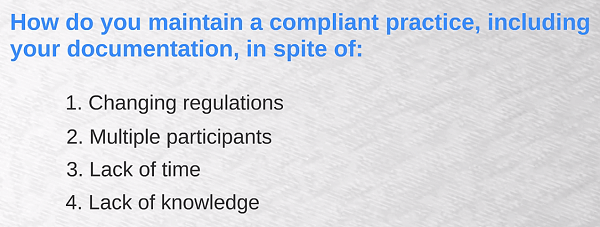
Three Key Practice Compliance Skills in a Genesis Training Webinar Compliance with laws and regulations is very important. Practice Owners and Management Staff regularly have questions about how to maintain a compliant practice, including patient visit documentation. How can you keep up with changing regulations and multiple participants when you have a lack of knowledge and a lack of time? Watch this free webinar to learn more. Read the transcript: Reuven: Hey, everyone, and welcome to our webinar today on “The Secrets to Prevent Compliance Failure.” Compliance, obviously, is one of the biggest things that preys on practices today especially in the physical health realm. Whether you’re a chiropractor, physical therapist, mental health, it really doesn’t matter. Across the whole spectrum, you know, you see these situations where compliance becomes a real problem. And so when we talk today, we’re gonna get to the root cause of the problem. We’re gonna talk about, what is so important when it comes to compliance and how is it that our solution really helps you to prevent issues with compliance? And in order to do that, we’re gonna talk about obviously, why that problem is important, why compliance is important. We’re also gonna talk about why compliance is so difficult. You know, one of the biggest questions we get asked on a regular basis is why can’t this just be super easy? And there are solutions out there that will try to do that for you, but often times, they won’t do it in a compliant way, and so you end up being faster but less compliant which, in the end, is not good for your practice. So the real question is how do you maintain a compliant practice? You know, and that includes your documentation. And really, the question becomes more specific in that you have to maintain compliance in spite of things like changing regulations and, of course, we talk about how regulations will change starting with the federal level, with Medicare, and then Blue Cross Blue Shield, and then out to the rest of the commercial insurances, and then, of course, then to the state boards. And the next issue is with multiple participants, you know, different people that have their hands, that have their fingers in different pies and, of course, obviously, a lack of time, you know, with regards to just how much time you can spend. You know, it’s easy to say that if you had an hour per document that you could be super compliant without even using a system, but it’s really not practical. And the other side of it is that as a clinician, you know, we’re really trained to treat patients, not treat, you know, a healthcare system that requires so much of us. And so this lack of knowledge becomes a real debilitating situation to the point where, you know, there’s an entire industry surrounding compliance outside of solutions like ours where, you know, practices will spend lots and lots of money to make sure that they can avoid losing a lot more money. And so this problem really is really big and really complex and, you know, what we’re gonna try to do today is really simplify that problem and make it easier to understand and easier to solve. So the next question is why is it important? And that really comes down to a few things, and the first one is, in the course of running a practice, you know, there’s always gonna be an expected rate of error. So this is a really basic idea. No matter what you are doing, there’s always going to be mistakes that are made, and that’s just a factor of being human. And a lot of people say, “Well, if you automate it all, then you get rid of mistakes.” And what we find actually is, in technology, there’s also an expected rate of error. For example, you know, any of you, Windows users, will remember when the new version of Windows comes out, there are always issues with it, and so, they always have to update it, and you always have to download these Windows’ updates. And we find the same thing with Apple. Everybody remembers the big debacle with…I think it was Apple iOS 5 or 6 where, you know, things just started crashing on devices like iPads. And so what we find is that there’s always a percentage of error especially when you have people, especially when you have technology, but especially when you have both working together. And so it’s not a matter of saying, “All right, well, I expect errors which means that I’m kind of at a loss to begin with,” it’s more a matter of, “Okay, I understand that there’s a problem, the next question is how do I address that problem?” So we wanna understand that, of course, any errors can result in costly penalties, we wanna be aware of the effect of our mistakes so that we can focus on ways to minimize them. So the next question really becomes why is it so difficult to solve? And so with so many moving parts in a practice, you know, you’re dealing with yourself as an owner or yourself as a front office practice manager, whatever it is you’re doing, but you have practitioners, you have front office staff, you have practice managers or office managers, you have the patients, which are the most moving part in your office, you know, and then, of course, you have all the supporting things like the solution that you’re using or anything like that. So you have lots and lots of moving parts with different people, some of which have different processes and, really, that are relying on different technologies. And so take all of that and then add the complexity of a constantly changing environment with regulations. And, of course, knowing that you might have different sets of regulations because Medicare might have changed things before
The Secret to Understanding Chiropractic Practice Cashflow

Obviously, Cashflow will help your Practice grow! On Cashflow: Practice owners and staff regularly have questions about where their payments are, how they can see which insurance companies are helping them, and/or which patients are struggling to pay their bills. Fortunately, with a single report, practices can now periodically review where their payments are and how well their office is functioning, while comparing the metrics that are most important to their success. Watch this free webinar to learn more.
Chiropractic Documentation Fast and Compliant Notes
Fast and Compliant Notes for Chiropractic Practices Documenting cases quickly while remaining compliant with both insurance and government regulations seems like an impossible task. Especially when you factor in the images, forms, tests and more that go into proper documentation. Fortunately, it’s now possible to compile all the information you need, quickly, from a single screen. Watch this webinar to find out how! Read the transcript: Reuven: Welcome to Genesis’s webinar on compliance. Today we’re gonna talk about the travel card. My name is Reuven Lirov. I am currently the Chief Growth Officer and I work with over 500 practices and more than 1,600 practice staff across multiple specialties. My team posts more than $10 million in monthly insurance payments, focusing on finding ways to accelerate practice cash flow, improve compliance, and foster office staff teamwork. In the past 5 years, our clients have seen an average revenue growth of over 186%, patient visit growth of over 141%, and an 86% increase in patient visit compliance. So let’s get right down to it. Really what we wanna talk about today is the need to be able to complete and review documentation as quickly as possible. And this is a need that comes up all the time. Anytime we talk to some who is struggling with their current solution opening a new office, expanding their office and needs something that’s more scalable, the biggest problem they have is that they wanna spend more time with their patients, less time in a solution, and they wanna still stay 100% compliant with state insurance and federal requirements. So it’s a really difficult problem to solve, and each issue plays into the other. So this problem is really critically important because documentation obviously is a critical component to practice success. You know, one thing that happened to me a lot was as an EMT was when I was in college, we would constantly have to be reminded of the need for very, very clear documentation, especially when you’re dealing with outside patients where, you know, if you didn’t write it down, it didn’t happen. And that was the go-to phrase that we would give to new recruits, “If you if you didn’t write it down, it didn’t happen.” And even though you’re trying to do that, the goal is to have notes that take seconds. You wanna be able to spend most of your time interacting with your patient and a fraction of that time documenting so that all of your patient interactions are maximized. Because at the end of the day, it’s all about making sure that that patient is getting better and that patient is getting so much better that they’re feeling compelled to bring in their family, and their friends, and anyone else that they know that may be suffering or need your help. So even though we understand what this problem is, we understand why it’s important, there are still so many practices out there that are struggling, and so it’s obviously a difficult problem. And so compliant notes really struggle to be fast notes. That’s not an easy problem to solve, and if it didn’t matter how specific the notes were to anyone but yourself, you would do what a lot of providers do today, which if you ask them, you know, they’ll admit to it, they won’t be happy about it, but the reality is a lot of them scribble notes down. And if that’s you, don’t worry about it, we’re here to help. You know, a lotta the time I hear things like, you know, scribbling things down, stuffing them into a paper file, and spending the majority of your time with your patient, which is what you should be doing, really. But you really don’t have a choice because, you know, you need to have a compliant note and you need to have a referring patient. And so obviously this won’t work. You know, you gotta be able to finish your notes quickly, but you still have to stay compliant. And, you know, if that’s not something that you’ve struggled with recently, statistically speaking, every practice, if it’s in business more than five years will eventually get audited by a state board or a regulatory agency like an insurance company, something like that. So get ready for that. And it’s…you know, if you haven’t done it yet, it’s time to get that house in order. So documentation often spans more than just soap notes. So when you think about documentation, we have to think about the entire patient’s care. And so the soap note is one piece of that, your subjective objective ADL assessment and plan, but there’s also images, there’s forms like intake forms, and verification of benefits, and medicare forms, lengthy tests, and so much more, especially if you’re dealing with a multi-specialty practice where you’re bringing in, you know, different specialties that compliment your own. So the question is really, what’s our approach? You know, the reason why we’re so successful in working with our practices is because we look at the practice the way you look at your patients. Instead of trying to solve an individual symptom, which is I spend too long documenting, we really wanna understand the root cause of the problem. So we wanna look at this really in five areas. We wanna talk about the patient’s travel card, we wanna talk about that patient’s history, wanna talk about billing, wanna talk about personal notes, we wanna talk about documentation. A lotta the time I hear things like, “Well why do I need to talk about billing if we’re talking about documentation? Why do I need to talk about the patient’s history or even scheduling when I’m talking about documentation?” And so when you try to take into account the issues surrounding documentation and trying to get patients better, if you’re not able to connect your billing the rest of your documentation to your soap note, including
The Secret to Better Practice Management Decisions

Learn how to use metrics for better decision making! Metrics are what you need. When it comes to managing your practice, it’s often difficult to make informed, timely decisions without data. That’s because practice owners are frequently unsure of which performance indicators they should measure, or even how to get started. Or, they ignore the data and operate on instinct. Analytics, however, take the guesswork out of practice management, while simplifying the data so it can be easily understood. These tools provide increased efficiency and effectiveness, for improved decision-making ability.
Patient Education for Chiropractic Practices

Complications Does the complexity of Dr. Ben’s patient education needs require a complicated solution? “It’s nice to be in someone else’s restaurant for a change,” Carmen remarked. “Someone else will have to do the cooking and the dishes!” “Rough day at the pizzeria?” “Not a bad day,” said Carmen, “but this time I’m being affected by new governmental medical regulations.” “What?” Ben was taken aback. His chiropractic office dealt with medical regulations frequently, but he couldn’t see how they could affect his wife’s pizza parlor. “We have to provide full nutritional information on our menus now.” Carmen sat back, waiting for Ben to share her outrage. “That’s a good thing,” Ben said. “People should know what they’re doing when they order that sausage and pepperoni thick crust with extra cheese.” “But that’s just the point! We don’t offer a couple dozen dishes the way this restaurant does. People can order their pizza with half a dozen different kinds of meat, twice that many vegetables, several different crust options, five different sauces, plus extra this or hold that — there are thousands of different combinations.” Ben was taken aback. “I hadn’t thought of that. But the research I’ve been doing on patient education has me convinced that people really do need full health information presented to them. My patients have to understand their diagnosis or disease, plus the treatment options we’re considering, as they relate to the specific part of the body where the patient is having trouble. That might have as many permutations as your pizza ingredients.” Their waiter arrived and Ben and Carmen ordered, pausing in their conversation to discuss their choice of dishes. Carmen jumped back in as soon as the waiter turned away. “Most people don’t even look at the menus, anyway — they know what kind of pizza they like. And they know that pizza is a bit of an indulgence. Maybe they just had a salad for lunch and plan to go roller skating after dinner. How is it my responsibility to police their health choices?”“It’s not about policing,” Ben objected. “It’s about giving people the information they need to make good choices. I see that the nature of your product makes it hard to provide the information you’re being asked to provide, and that’s true for my patient education situation, too, but that doesn’t make it any less of a good idea.” “Have you found a solution?” Carmen asked. “Maybe it’ll work for me, too.” Ben smiled. “I’ve found this amazing library of 3-D medical images and animations. It’s in the cloud, so we can all access them from every room–” “Unlike anatomical models or charts,” Carmen put in. Ben nodded. “We can email patients custom reports to help them keep up at home — and it’s fully integrated with that new software system we’ve been planning to implement. That means that it’ll fit into the workflow instead of changing it — and I know the whole team will be happy about that. It’s a simple, elegant solution to a complicated problem.” “It sounds perfect!” “I think it will be. Ah, here’s our dinner. Now we can see about coming up with a solution for your health education issue.” Does the complexity of Dr. Ben’s patient education needs require a complicated solution? Disclaimer: For HIPAA compliance, all characters appearing in this post are fictitious. Any resemblance to actual persons or actual events is purely coincidental.
Chiropractic Practice Management Decision Making

Wake Up and Smell the Coffee Dr. Ben might be able to make better decisions by tracking KPIs — but would it be worth it for practice management? “Do you really cut out coffee in the break room when cash flow is tight at the practice?” Carmen asked Ben, pouring him a cup of her special brew. Ben inhaled the aroma of freshly ground coffee beans brewed in a French press with filtered water. Their son was coloring at his end of the table while Ben and Carmen enjoyed a cup of coffee, the family’s usual evening ritual. “Why not? It’s a small thing that doesn’t affect the patients,” said Ben, breathing in the scent of coffee again. It would be just another minute before it reached the ideal drinking temperature. “I think that’s a mistake,” Carmen said firmly. “What happens when everyone is crazy busy all day and the waiting room is a zoo and Pam goes for her coffee break — and finds no coffee. You save yourself seven dollars, and you have a dissatisfied staff. That’s no bargain.” “So where should the savings come from if we need to scrimp a little bit? Sometimes we have to.” “There’s always something you can do to bring in a little more money in the short term,” Carmen said, swirling her cup. “You can call patients you haven’t seen in a while and invite them in, or offer a referral bonus or something.” “This isn’t like pizza,” Ben objected. “Plus, we don’t always have too little business when we have a cash flow issue.” Carmen frowned. “The solution to every problem in business is more customers. Cash flow for the pizzeria means we’ve had a slow week. It’s not that way at the practice for practice management?” “Not necessarily. There are a lot of things that can affect our income. No shows, for example. When people make an appointment but don’t show up, we lose that income. NFAs, no future appointments — those are the people who may have been coming regularly and providing predictable revenue, but then they leave without making another appointment.” “Recurring revenue is good,” Carmen agreed. “But when you expect it and it doesn’t happen, it can take a while to make up the difference.” “There’s also payment. When people order a pizza, they pay for it. We have accounts that are 60 or 120 days late, plus insurance payers who are slow or even dispute the claims.” “Hold on!” Carmen grabbed a piece of paper and a crayon from Jonathan’s hoard. “Can I have this one, sweetie? Thanks. Okay, Ben, let’s get this figured out. Things affecting your income include no-shows, NFAs, slow pays, and payers like insurance companies that aren’t always predictable. It’s all practice management.” Carmen drew a neat chart with the crayon. “Wait, I think the insurance companies need their own column. You need to keep track of which payers are fast and cooperative and which aren’t. You also need to know how many claims you have and when there’s a significant backlog so you can respond to it. Maybe also which specific procedures cause problems with which payer.” Ben admired the chart. “Looks like that about covers it.” Carmen sat back and admired her work. “I think these are your KPIs. Your key performance indicators that let you see if you’re on track and if you need to trim your costs a bit.” “Where will these numbers come from?” Ben asked. “You’re acting like I should know these things.” “You should,” Carmen shot back. “You have to know your numbers to make the right decisions at the right time. When you know your numbers inside and out, you can make strategic decisions wisely. Maybe there are vendors you can safely put off paying if you know that you have money coming in soon, or maybe you can put a staff member to work getting those overdue accounts cleaned up.” Carmen returned the crayon to their son. “Either way,” she went on, “you won’t have to mess with the coffee!” Ben drained his cup. He could see where Carmen was coming from. Her plan sounded sensible. But he wasn’t sure it would be worth taking time away from what he did best — patient care — to mess with all those numbers. Dr. Ben might be able to make better decisions by tracking KPIs — but would it be worth it for his practice management? Disclaimer: For HIPAA compliance, all characters appearing in this post are fictitious. Any resemblance to actual persons or actual events is purely coincidental.
