
Chiropractic Software includes all ICD-10 codes

Are you and your Chiropractic Practice ready for ICD-10 and all of the new billing codes that you’ll need to know? Learn more about how your billing and collections will be impacted and learn how to avoid denied claims and underpayments. Read the transcript: Jess: All right. Good afternoon everyone and thank you for attending our webinar on ICD-10. Today’s presenters are Kathleen Casbarro and Mellisa Levine. Kathleen is the head of our SWAT department and she is a certified coder. She has been in this industry for 30 years and we have Mellisa Levine who is the head of our support department here at Vericle and she is responsible for over a hundred professionals, that’s been 500 practices and post 14 million in monthly payments. So welcome Kathleen and Mellisa. Kathleen: Thanks, Jess. Appreciate that. Just wanna welcome everybody today to our ICD-10 webinar. The webinar today will be 30 minutes. The reason why we do this in half-an-hour because its a lot to take in and if we can deliver our message in 30 minutes to you, of course, if you want additional information from us after the webinar please feel free to reach out. Jess, at the end, will give you our contact information. So I wanna welcome all of you and I hope most of you on this phone have not had to dig out of 12 inch of this snow, but hopefully, we can make your lunch half-hour at least entertaining. Our focus for today is really understanding the complexity of ICD-10, that is our learning objective. We all know that ICD-10 is coming and it’s gonna hit us on October 1st, 2014. For a lot of us who are in the health care industry, were actually looking for ICD-10 to hit us on October 1st, 2013, but they gave us a year reprieve. In saying that though people actually wonder why, you know, why are we having conversations so early in the game? Why are we talking about ICD-10 in January? Well, a lot of us have actually been talking about ICD-10 for years and talking about it early is really the best way to start. We do know that it is coming in 9 months, but in this particular case if any of you on the phone are familiar with 50-10 that was a struggle, this is gonna be even more difficult because it’s gonna involve a lot more people within your practice. So we really wanna talk about ICD-10, why it’s a problem and how we have to work together to fix it. So really what is the problem? Why is ICD-10 such a big issue? And you know you’re seeing this guy in a car kind of on the edge of a cliff feeling like he’s gonna fall over it because everybody’s so worried about it. And there is a good reason to worry because it’s gonna impact you. It’s gonna impact your practice. Is it going to take away time from your patients? Really, that’s what we want to avoid. Everybody is out there to help their patients. You wanna help them get better and stay better. What we don’t want this to do is really impact your patient care. The purpose for ICD-10 is to improve patient care. The reduction on cash flow, that’s something we always have to worry about. Not only reduction on cash flow, the cost of implementing a major change like this into your practice and everybody always worries about office workflow change, you know, do I have to hire more people? Do I need different computers? How do I have to upgrade my system? Should I upgrade now? How about testing and superbills. We do have…people are out there still using paper superbills. Think about it, right now, you’re looking maybe at a one-page superbill in front of you with ICD-9 codes. We’ve seen these translations turn from a 1-page superbill into a 10-page superbill. The last thing we want our docs to do is you know, walk around the office with a ream of paper. The new office superbill really should be something that’s an electronic format to avoid all of that paper and you know, you’re gonna have a difficult time trying to find your codes on 10 pieces of paper. So those are the things…that’s why this problem is so hard to solve because there’s so many things that we have to focus on. And one of the other things that we have to focus on and we all, you know, shrug at this is really the payer readiness and Jess introduced Mellisa in the beginning, I’m actually turning this over to her and Mellisa’s really gonna talk to us a little but about monitor paying readiness. Mellisa: Thanks, Kathy. So payer readiness is one of the other things that makes this just really complicated and a transition that’s very hard to handle because not all the payers are gonna be ready at the same time. So the official deadline is October 1st, 2014. Some payers are gonna be ready early so you may have one of your payers that’s ready in, let’s say July, another one in August, another one in September and there’s gonna be some payers like we saw the transition to 50-10 though that also had a hard deadline. Some payers weren’t ready for months or even years afterwards. One of the things that makes this real complicated is knowing which codes go to which payers. Kathleen: You know, I agree with you there Mellisa and I have to say, you and I have been attending numerous webinars with clearing houses, I mean how many have we attended honestly? Mellisa: I can’t even count at this point. Here’s the question though? Did we get a clear message from any of our clearing houses as to when any of these payers or themselves will be ready? Kathleen: Clearing houses are starting to have some idea, but based
The Secret to Understanding Chiropractic Practice Cashflow

Obviously, Cashflow will help your Practice grow! On Cashflow: Practice owners and staff regularly have questions about where their payments are, how they can see which insurance companies are helping them, and/or which patients are struggling to pay their bills. Fortunately, with a single report, practices can now periodically review where their payments are and how well their office is functioning, while comparing the metrics that are most important to their success. Watch this free webinar to learn more.
Own the Phone with Spencer Peller

Spencer Peller is the Co-Founder and CEO of YesTrak and Founder and CEO of MyDoctorCalls. He is also the author of the new book Own the Phone! Today’s training is all about your telephone! If you’re a business owner, you know how important your telephones really are. This training will help you understand every aspect of answering the phone. It’s also a great training for your staff, so make sure you send this link to them and tell them to watch it. Click the interview below to get started… For more information about YesTrak: Visit: www.YesTrak.com Call: (800) 620-5877 Send email to info@yestrak.com
Chiropractic Documentation Fast and Compliant Notes

Fast and Compliant Notes for Chiropractic Practices Documenting cases quickly while remaining compliant with both insurance and government regulations seems like an impossible task. Especially when you factor in the images, forms, tests and more that go into proper documentation. Fortunately, it’s now possible to compile all the information you need, quickly, from a single screen. Watch this webinar to find out how! Read the transcript: Reuven: Welcome to Genesis’s webinar on compliance. Today we’re gonna talk about the travel card. My name is Reuven Lirov. I am currently the Chief Growth Officer and I work with over 500 practices and more than 1,600 practice staff across multiple specialties. My team posts more than $10 million in monthly insurance payments, focusing on finding ways to accelerate practice cash flow, improve compliance, and foster office staff teamwork. In the past 5 years, our clients have seen an average revenue growth of over 186%, patient visit growth of over 141%, and an 86% increase in patient visit compliance. So let’s get right down to it. Really what we wanna talk about today is the need to be able to complete and review documentation as quickly as possible. And this is a need that comes up all the time. Anytime we talk to some who is struggling with their current solution opening a new office, expanding their office and needs something that’s more scalable, the biggest problem they have is that they wanna spend more time with their patients, less time in a solution, and they wanna still stay 100% compliant with state insurance and federal requirements. So it’s a really difficult problem to solve, and each issue plays into the other. So this problem is really critically important because documentation obviously is a critical component to practice success. You know, one thing that happened to me a lot was as an EMT was when I was in college, we would constantly have to be reminded of the need for very, very clear documentation, especially when you’re dealing with outside patients where, you know, if you didn’t write it down, it didn’t happen. And that was the go-to phrase that we would give to new recruits, “If you if you didn’t write it down, it didn’t happen.” And even though you’re trying to do that, the goal is to have notes that take seconds. You wanna be able to spend most of your time interacting with your patient and a fraction of that time documenting so that all of your patient interactions are maximized. Because at the end of the day, it’s all about making sure that that patient is getting better and that patient is getting so much better that they’re feeling compelled to bring in their family, and their friends, and anyone else that they know that may be suffering or need your help. So even though we understand what this problem is, we understand why it’s important, there are still so many practices out there that are struggling, and so it’s obviously a difficult problem. And so compliant notes really struggle to be fast notes. That’s not an easy problem to solve, and if it didn’t matter how specific the notes were to anyone but yourself, you would do what a lot of providers do today, which if you ask them, you know, they’ll admit to it, they won’t be happy about it, but the reality is a lot of them scribble notes down. And if that’s you, don’t worry about it, we’re here to help. You know, a lotta the time I hear things like, you know, scribbling things down, stuffing them into a paper file, and spending the majority of your time with your patient, which is what you should be doing, really. But you really don’t have a choice because, you know, you need to have a compliant note and you need to have a referring patient. And so obviously this won’t work. You know, you gotta be able to finish your notes quickly, but you still have to stay compliant. And, you know, if that’s not something that you’ve struggled with recently, statistically speaking, every practice, if it’s in business more than five years will eventually get audited by a state board or a regulatory agency like an insurance company, something like that. So get ready for that. And it’s…you know, if you haven’t done it yet, it’s time to get that house in order. So documentation often spans more than just soap notes. So when you think about documentation, we have to think about the entire patient’s care. And so the soap note is one piece of that, your subjective objective ADL assessment and plan, but there’s also images, there’s forms like intake forms, and verification of benefits, and medicare forms, lengthy tests, and so much more, especially if you’re dealing with a multi-specialty practice where you’re bringing in, you know, different specialties that compliment your own. So the question is really, what’s our approach? You know, the reason why we’re so successful in working with our practices is because we look at the practice the way you look at your patients. Instead of trying to solve an individual symptom, which is I spend too long documenting, we really wanna understand the root cause of the problem. So we wanna look at this really in five areas. We wanna talk about the patient’s travel card, we wanna talk about that patient’s history, wanna talk about billing, wanna talk about personal notes, we wanna talk about documentation. A lotta the time I hear things like, “Well why do I need to talk about billing if we’re talking about documentation? Why do I need to talk about the patient’s history or even scheduling when I’m talking about documentation?” And so when you try to take into account the issues surrounding documentation and trying to get patients better, if you’re not able to connect your billing the rest of your documentation to your soap note, including
The Secret to Better Practice Management Decisions

Learn how to use metrics for better decision making! Metrics are what you need. When it comes to managing your practice, it’s often difficult to make informed, timely decisions without data. That’s because practice owners are frequently unsure of which performance indicators they should measure, or even how to get started. Or, they ignore the data and operate on instinct. Analytics, however, take the guesswork out of practice management, while simplifying the data so it can be easily understood. These tools provide increased efficiency and effectiveness, for improved decision-making ability.
Revenue | Getting Started with Billing Software

Prepare for Launch! Getting Started with Billing Software. Dr. Wilson and Luisa make final preparations to dive into their Genesis adventure together As Ben sipped his coffee and checked his email, Luisa peeked her head into the doorway and asked, “Are you ready, Dr. Wilson?” Ben smiled and said, “I’m not sure, but let’s go ahead anyway.” Luisa dialed the phone number for Charlie, their Genesis coach. After a couple of rings, Charlie picked up on the other end. “Good morning,” he said cheerfully. “So today’s the big day!” “Hello Charlie,” laughed Ben. “It sure is. And I think we’re finally ready.” “Then let’s get started – we’re going to talk about the features of Genesis that will be most useful for your practice and offer that final bit of reassurance that you’re doing the right thing,” Charlie said. “They don’t call me the King of Practice Success Coaching for nothing!” “OK Charlie, we’re ready,” said Ben. “Let’s go through this one last time.” “Let’s start with the ‘why’ of the Billing Stats Report, and relate it to some of the challenges you may be experiencing in your practice,” Charlie said. “You’re doing pretty well financially but have you ever experienced any sudden drop-offs in revenue that you couldn’t easily explain?” Luisa and Ben looked at each other and could remember several occasions when that was the case. Just a few months ago they had seen a significant and disturbing reduction in revenue and it had taken weeks of going through billing records, manually, to learn that Pam had been writing the wrong billing code on a number of Ben’s patient files. Every single one of those claims was delayed or denied outright. They were still trying to get some of the accounts sorted out. “Yes, we’ve found it very difficult to troubleshoot issues with reimbursements,” admitted Luisa. “And it’s not always the insurance companies’ fault – getting even one number wrong in the coding or forgetting to include important documentation can really impact our success in collecting what we’re owed.” “Exactly, it’s about achieving billing compliance AND payer compliance,” Charlie said. “But it’s important to recognize that the insurance companies are not going to give you a step-by-step reporting on the progress of your claims – it’s better for them if you’re not able to stay on top of the process.” “I’m sure I’ve mentioned to you before that the chance of getting paid on a claim decreases by 1 percent with each passing day,” he continued. “That 1 percent adds up really quickly when you’re talking about an entire practice’s worth of patients and numerous claims.” Ben and Luisa both had to swallow hard at the thought of the tens of thousands of dollars they had lost due to reimbursement issues. “It really is amazing the detail you can get,” Charlie said. “The reports are customizable to your particular needs and will tell you where problems are – whether on your end or the insurance company. Perhaps there are two codes on a claim that don’t quite go together, or a clinician forgot to include some demographic information in the claim … or maybe an insurance company is consistently underpaying certain CPT codes, or pushing the boundaries of its accounts receivable window. You can’t fix problems until you know what they are!” “That’s true,” said Ben. “I definitely don’t envy Luisa – she’s been an incredible investigator when it comes to solving cash flow mysteries but the time she has needed to dedicate to these investigations has definitely taken crucial time away from other office management needs.” “If the roots of billing problems were easy to find, we’d be able to deal with them quickly and decisively,” said Luisa. “You know how I love to have a plan!” Ben nodded and smiled. “And it’s not just insurance companies,” Charlie said. “You can stay on top of private payers, as well, and make sure that your patients are on track with visits and billing.” “That would be really helpful,” said Luisa. “We’ve had several patients who were significantly behind and once we figured out where their accounts stood, it was a real financial hardship for them to try and catch up all at once.” “But it’s not all about reimbursements – what’s great about Genesis is that it provides you with a checklist for all of your performance indicators, such as unbilled visits, patient visits, no shows, unfinished claims, or any other success measures you’d like to track,” said Charlie. “Another great feature is the radar chart, which allows you to see certain areas within your practice where attention may be needed,” he continued. “You can set parameters, such as new patient numbers, so that you will know if you’re not meeting your goals. Once you’ve set the desired parameters for a number of performance indicators within your practice, then you won’t need to refer to the Billing Statistics Report – unless the radar indicates there is a problem with performance. Between the radar and the Billing Statistics Report, you are going to be firmly in control of your practice’s financial health and performance.” “This is incredible,” mused Ben. “Being able to focus on building this practice instead of worrying about when reimbursement checks are going to arrive? I really didn’t think it was possible.” “I know you’re still probably a little intimidated about getting started but let me offer this final testimonial: In the past three years, my clients have seen average revenue growth of over 186 percent, patient visit growth of over 141 percent, and an 86 percent increase in patient visit compliance,” Charlie said. “Your patients will have more buy-in with regard to their own health care, you will have less administrative work to slog through, you will collect more money and – best of all – you will be able to spend more time with your patients.” “Well, that’s what we’re all here for,” said Ben. “Let’s do this!” Is Genesis the solution Ben’s
Revenue | Automating Billing Reports

Where Should We Go Tonight? Can Dr. Ben make the commitment to automate his billing reports and take control of his office finances? Ben and Carmen were having a familiar conversation: what should we do about dinner? They had both returned home from busy days at work, both were a little frazzled and hungry and – as usual – the refrigerator was lacking in appetizing options. “I’ve heard that the new Indian buffet is very good,” said Carmen. “But it’s downtown and it’s almost 6:30, so there might be a bit of a wait.” Ben thought about that. “That sounds delicious and we should definitely get there at some point, but I’m too hungry for a long wait. Why don’t we just go grab some Chinese at our usual place – there’s never a wait there.” “You know, Ben, we’re never thrilled with our meals there and we’ve tried everything on the menu,” Carmen said. “There’s a pretty good reason why there’s never a wait there.” They looked at each other testily for a moment – hunger and a lack of accord might become a threat to their nice evening out. Just then Jonathan came running out of the living room and hugged Ben, happy to see his father. “Daddy, you’ve got to see my new art book – I drew all of the pictures myself!” “Of course, Jonathan, I’d love to see it,” Ben said. “Listen, Carmen, I’m going to look at Jonathan’s artwork and then we can go try that new restaurant downtown. It sounds like fun.” He went into the living room with Jonathan and sat down on the couch with him. He wondered why he was so irritable this evening as he turned the pages of the book. Ben’s thoughts kept returning to earlier in the week, when Luisa explained the difficulty she was having keeping track of the office finances. Too often they were surprised to learn that some patients had accounts that were past due. And between varying accounts receivable windows and some insurance companies that were dragging out the reimbursement process due to even minor errors in data entry, it was making confident budgeting impossible. Ben pondered how difficult it was for him to keep track of crucial patient information until he put a system in place. Between his voice recorder, written notes and meticulously organized files on his computer, he felt confident in his mastery of the most important details for each patient. But then he thought about how many areas of office management that Luisa was expected to stay abreast of: office supplies, scheduling, working with outside vendors, insurance reimbursements… her plate was truly full, even with Pam’s able assistance. And considering that third parties don’t always respond when and how you want them to, the level of complexity and the time it takes to handle each task can be multiplied exponentially. Carmen – who had a business degree and always seemed to be several steps ahead of Ben in understanding the ins and outs of finance – and he had talked about the program that could automate many of the functions of his office and Ben had been serious about actually following through and implementing it. But there always seemed to be a crisis to attend to… trying to collect from patients who owe balances beyond a certain date, trying to figure out where long-overdue insurance reimbursements were. Ben knew when he started his practice that it wouldn’t only be about attending to patients – he knew there would be crucial administrative work that would have to be handled by his staff. Luisa had certainly had shown she understood the benefits of having data to inform business decisions. But customization is key when reviewing large amounts of detailed data and it didn’t seem like Luisa was tapping the full potential of the system when it came to the billing reports. Ben knew that there were reports that could be broken down in a number of different ways and could be endlessly customized so that they could stay on top of potential problems. Well, maybe we should take some time to figure it out together, Ben thought. Without getting these reports done – and done right – we really have no idea how well our office is functioning. This sounds like something we should talk about on Monday. But first he wanted to enjoy a nice dinner with Carmen and Jonathan. He appreciated how Carmen listening to him talk about the various issues in his office, and she often responded with some great feedback. That business degree had served both of them well over the years. When Ben had finished looking at Jonathan’s artwork and congratulating him on being the next Rembrandt, he found Carmen in the hallway, ready to go – her purse in one hand and a small lunchbox in the other. “What’s in the lunchbox, Carmen?” Ben asked. “Well, since you’ve agreed to my pick of restaurants, I wanted to reciprocate by packing some snacks for the drive so you won’t be starving while we wait for a table,” Carmen said with a smile. “I’ve got some fruit, cheese and crackers, and your favorite – cashews.” Ben took Jonathan’s hand and smiled at Carmen, who never failed to make even the most hectic and frustrating day better. “We’d better get going,” he said. “Maybe we can be on the lookout for a new Chinese place on our way there.” Both were laughing on their way out the door. Can Dr. Ben make the commitment to automate his billing reports and take control of his office finances? Disclaimer: For HIPAA compliance, all characters appearing in this post are fictitious. Any resemblance to actual persons or actual events is purely coincidental.
Visual Embedded Analytics in Your Software
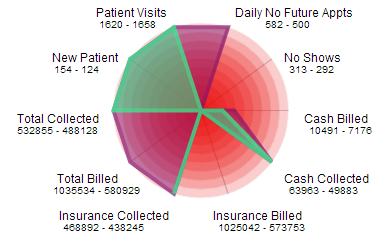
Can of Worms What do the numbers mean to you and your practice? Opening your own practice means opening a whole new can of worms. That’s because there are so many elements that they don’t teach you about in school: aspects of running a business that you’re left to learn on the fly — all while attempting to provide quality care for your patients. One of the most critical components of achieving practice success is making sense of the numbers. There are numbers everywhere, from revenue to no-shows, from patient visits to accounts receivable. When you first start to look at them, it can almost seem like you’re staring at signs in a foreign language, hoping that the context might shed some light on what they mean. Practice management software can help, but until you know what numbers are most important to your practice — and how they signify growth or, conversely, difficulties — you’re still left wading through a mess of mathematical gobbledygook. Fortunately, there are analytics — tools to help you make sense of the data — available, and the best chiropractic software solutions, such as Genesis, embed those tools into the program so that they’re easily and immediately accessible. Offering a visual presentation of the numbers, these analytics finally make it possible for you to interpret and understand the numbers that drive your practice. Examples include: Radar chart — Visually resembling a spiderweb, the radar chart shows multiple variables on axes starting from the same point, radiating outward like spokes on a wheel. The length of the spoke is proportional to the magnitude of the data. This allows you to examine the correlation of values — say, accounts receivable and NFAs — that aren’t otherwise measured in comparable units. Trend report — A trend report presents data on a traditional line graph, thereby allowing you to see the peaks and valleys of your information — and the inter-relation of different data sets — over time. Histogram — With a histogram, you can choose three charts to show you a graphical representation of a single area of your practice over a given time period (weekly/monthly), depending on the selection. This allows you to gauge how your practice is doing comparatively for a set amount of time. Dashboard — A dashboard is an organized presentation of the numbers, so you can get an at-a-glance picture of where your practice stands on collections and outstanding work. Genesis, for example, can show you failed claims, AR > 120 and outstanding tasks — or “tickets” — on a single screen through its homescreen dashboard. Billing Stats Report — This type of report allows you to view claims by date of service. The report can then be broken down in a number of different ways, depending on what you’re looking for (customizable by practice). The Billing Stats Report, or BSR, is very useful for digging into problems. Ultimately, it’s up to you to determine which numbers provide the best snapshot of practice success; however, analytics are the tools that help bring that snapshot into focus.
Check Out These New Network Members July 2014

One hundred fourteen new members across 68 practices joined Genesis Chiropractic Software and Billing Network in July 2014! Congratulations! There is strength in numbers due to the shared knowledge – we call it the “Billing Network Effect,” as the billing performance of each member practice improves in step with the total volume of processed claims. Please welcome our new Genesis network members: Sierra Byers of Absolute Health LLC, Scottsdale, AZ. Nina Rodgers of Action Chiropractic, LLC, Steamboat Springs, CO. Carri Moore of Advanced Chiropractic, Yuba City, CA. Alexa Desjarlais, Riley Klassen, Kim Lacoursiere, Miria Mattucci, Crystal McDonald and Dustin Whitney all of Alberta Preventative Health Services, Calgary, AB, Canada. Mary Damico of Aliante Chiropractic & Integrated Health, LLC, Las Vegas, NV. Josh Knotts of Align Health And Wellness, LLC, Brentwood, TN. Tammy Stang of Aligned Chiropractic Corporation, Kelowna, BC, Canada. Vicki Gutierrez of All About Chiropractic, Madison, WI. Rachel Kasdras of All Health Chiropractic Center Inc., Royersford, PA. Tonya Cota of Apex Chiropractic, LLC, Eau Claire, WI. Jennifer Dewitt of Back To Health Chiropractic And Wellness, Winona, MN. Quincy Knovak of Benchmark Medical Group, Inc., Windsor, CO. Sue Lefevre of Bold City Chiropractic, Jacksonville, FL. Karie Mabe of Brittian Chiropractic Center, PLLC, Winston Salem, NC. Holly Penna, Nikki Thompson, Samantha Ward of Dr. Glen R. Burford DC, Collierville, TN. Steve Bucci and Melissa Kahn of Camp Chiropractic, Inc., Middletown, DE. Kimberly Flores-Morales of Carolina Chiropractic Of Charlotte, LLC, Charlotte, NC. Janice Demers and Suzanne Demers of Carrollwood Family Chiropractic, Tampa, FL. Michelle Graham of Cascade Family Chiropractic, Colorado Springs, CO. Helen Bonilla and Janelle Cohen of Central Jersey Spine & Wellness, LLC, Freehold, NJ. Emily Hackett, Tracy Oppenheim, Jamie Pier, Lindsay Sison and Kristen Witham all of Chiropractic Works, Oakland, NJ. Cayla Sondrol of Clairton Family Chiropractic, Fort Worth, TX. Tiffany Bartram of Cornerstone Chiropractic, Charlotte, NC. Leiah Castillo of Elite Family Chiropractic, Charleston, SC. Amanda Aurich of Essential Care Family Chiropractic, Chesapeake, VA. Jenna Gall and Marcus Gall of Essential Family Chiropractic, Brighton, CO. Missy Trent of Family Healing Chiropractic, Charlotte, NC. Rosa Sanchez-Setticase of Fort Bend Corrective Health Center, Missouri City, TX. Ashley Epkes of Great River Family Chiropractic, Moline, IL. David Schlussel of Dr. Matthew Stuart Green D.C., Oakland, CA. Jessica Hofling of Greenleaf Chiropractic, LLC, Wichita, KS. Aubrey King of Greenwood Family Chiropractic, Greenwood, IN. Chris Lewis and Eric Roger Walker of Gulph Mills Chiropractic Center, King Of Prussia, PA. Janice Dunphy of Hawk Nation Chiropractic, Manchester, IA. Shelia Carey of Holland Family Chiropractic Center, PC, Richmond, VA. Victoria Farrell of Hubbardston Family Chiropractic, Hubbardston, MD. Erica Cash of Innerlink Chiropractic, Wixom, MI. Kristen Infantolino of Integrated Chiropractic, Chattanooga, TN. Kristen Tolmie of Kratz Family Chiropractic, Stoughton, WI. Meaghan Fabrycki and Ashley Lamoureux of Livingood Family Chiropractic, Cary, NC. Kelsey Sitzmann of Rohe Chiropractic Prof, LLC DBA Inspired Chiropractic, Sioux Falls, SD. Bernadette and Tara Hoopmann of King Family Chiropractic, Cape Coral, FL. Rebecca Gardner, Dan Laux, Dr. Jonathan Laux, Kathy Laux, Sue Koester, Chelsea Scoby, Lynette Spencer and Mike Wang all of Jonathan D. Laux, DC, Lima, OH. Dustin EJ Critcher of Lifestrength Family Chiropractic, PLLC, Naples, FL. Venetia Hayes of Louis C. Hilliard,DC, Smyrna, GA. Gwen Calderon of Maryland Chiropractic, Silver Spring, MD. Kim Williams of Maximized Living Foundation, Inc., Los Angeles, CA. Stacy Ackley, Courtney Bowers, Dr. Matt Hennessy, Leanne Jones, Dr. Mark Mccullough and Allison Osborne all of McCullough Family Chiropractic, Battle Creek, MI. Paige Wolfe of NCV, PLLC, Shelburne, VT. Amanda Hybner of Oak Hills Chiropractic, San Antonio, TX. Kathryn Gray of O’Dell Family Chiropractic PC, Webster, NY. Alejandra Barrientos of Optimum Spine And Health Clinics, PC, Salt Lake City, UT. Shanice Bell of Pacific Spine & Joint Medical Group, Inc., Daly City, CA. Jamil Abdur-Raoof, Bakari Dark and Dr. Harry Derr all of Paris Chiropractic, Rockville, MD. Melissa Klein and Joshua Poole of Planet Chiropractic, Douglasville, GA. Dr. Kevin Plummer of Pure Life Chiropractic, LLC, Eugene, OR. Kelli Tedder of Pure Life Chiropractic, P.C. – Dr. Johnathan Davis, Florence, SC. Anne Leiker of Shuemake Family Chiropractic, Centennial, CO. Stephanie Roloson of Symmetry Spine and Wellness Center, Alameda, CA. Lacey H. of The Health Factory PLLC, Knoxville, TN. Amy Pedretti of Three Rivers Chiropractic, Onalaska, WI. Aaron Bebee, Alexa Boyce, Becky Clark, Garry Jawanda, Courtney Jegla, Sarah Little, Tory Paulson, Ian Quartermus, Amy Wirth, Cara Wirth, Monica Wohlfert and Ryan Wohlfert all of Total Health Chiropractic, Lansing, MI. Andrea Faulkner of United Chiropractic, Myrtle Beach, SC. Katie Korin of Vital Energy Chiropractic, Helena, MT. Julieann Van Cleve of Michael A Winters, DC, Paducah, KY. Amy Hamlin of Woodbury Family Chiropractic, Woodbury, MN. Pamela Belmonte of Woodland Family Chiropractic, LLC, Kentwood, MI. Kelsey Hughes and Michelle Magana of Zenaptic Chiropractic, Vancouver, WA.
All New Network Members in March 2014
Sixty-six new members across fifty-four practices joined Genesis Chiropractic Software and Billing Network in March 2014! There is strength in numbers due to the shared knowledge – we call it the “Billing Network Effect,” as the billing performance of each member practice improves in step with the total volume of processed claims in our chiropractic software. Please welcome our new Genesis network members: Kathryn Means and Tiffany Agler of 180 Chiropractic & Wellness, Franklin, TN. Anne Linder of Able Chiropractic, Apple Valley, MN. Dr. Graham Linck of Aliante Chiropractic & Integrated Health, LLC, Las Vegas, NV. Elizabeth Castor of All Health Chiropractic Center Inc., Royersford, PA. Steve Segovia of Backsmart Wellness Center, Edison, NJ. Rachel Reiser of Back To Health Chiropractic And Wellness, Winona, MN. Brian and Merissa Beard of Beard Family Chiropractic, Conway, AR. Zully Sanchez of Big Pine Key Chiropractic Inc., Key West, FL. Charlin Coley of Brittian Chiropractic Center, PLLC, Winston Salem, NC. Justin Kutz of CBP Spine Center, Windsor, CO. Ashley McCurley of Charles Cottier DC, Kilgore, TX. Shauna Smith of Chiropractic First, Mukwonago, WI. Samantha Fleming of Chiropractic Solution Center, PC, Virginia Beach, VA. Bryan Henss of Clairton Family Chiropractic, Fort Worth, TX. Stephanie Shaeffer of Discover Chiropractic, San Jose, CA. Melissa Sanchez of Dr. Derek D. Ferguson, Whippany, NJ. Mary Byrd, Gaye Lynn and Crystal Faulhaber of Dr. Glen R. Burford DC, Collierville, TN. Dr. Scott Richmond of Elite Spinal Rehab, PC, Urbandale, IA. Rachael Leboeuf of Family Healing Chiropractic, Charlotte, NC. Katalina Dean of Fort Bend Corrective Health Center, Missouri City, TX. Ashley Slominski of Freedom Chiropractic Health Center, Fargo, ND. Rachel Millsap of Freedom Family Chiropractic, Centerville, OH. Sheila Willis of Greenwood Family Chiropractic, Greenwood, IN. Jennifer Maciuk of Justin Ard DC, PLLC, Brentwood, TN. Jena Lujan of Hawk Nation Chiropractic, Manchester, IA. Carol Payne and Leah Wilson of Indy Family Chiropractic, Indianapolis, IN. Colton Kaminski and Kali Oestreicher of Infinity Wellness And Chiropractic, Plover, WI. Kelly Fennelly of Innerlink Chiropractic, Wixom, MI. Liz Halen of Jon Scott Chiropractic, Inc, Thousand Oaks, CA. Alyssa Anguiano of Keen Family Chiropractic, Austin, TX. Judy Kestner and Jessica Nelson of Kestner Family Chiropractic, Nashville, TN. Doreen Wiszowaty of Life Is Good Chiropractic, LLC, Brodheadsville, PA. Marie Welsh of Livingood Family Chiropractic, Cary, NC. Cycy Felty of Lombard Chiropractic, Lombard, IL. Sean Lamont of Lone Star Family Chiropractic, Katy, TX. Xavier Counts of Middletown Family Chiropractic, Middletown, KY. Jacqueline Morgan of Mission City Chiropractic, LLC, San Antonio, TX. Miroslaw Polanski, Danielle Soto and Cathy of Miroslaw Polanski, Brooklyn, NY. Tenisha Collins of Next Level Health, Rockford, IL. Summer Middaugh of Ozanne Family Chiropractic, LLC, Fayetteville, AR. Jan Lowenstein of Pete Lowenstein DC, Brick, NJ. Courtney Hays of Providence Chiropractic, Hermitage, TN. Janel Laban and Tesha Davilmar of Richard A. Henry DC PA, Lauderhill, FL. Dr. Mark Wolfman and Janelle Wolfman of Rivertown Family Chiropractic, Grandville, MI. Adreana Biskey of Rosemount Chiropractic, Rosemount, MN. Claudia Gallego of Shin Wellness, LLC, Miami, FL. Dustin Hirsbrunner of Smith Family Chiropractic, Austin, TX. Steven Martin of Sports & Spine Chiropractic, Dallas, TX. Danielle Flatmo of Stability Spine & Wellness, Seattle, WA. Patrice Mckinnon of The Balanced Spine, LLC, Issaquah, WA. Christine James of Total Lifesytle Chiropractic, PLLC, Scottsdale, AZ. Katie Boyd of Wells Family Chiropractic, Asheville, NC. Rebecca Scott and Tabitha Ashley of Wickiser Clinic Of Chiropractic, Anderson, SC. Evelyn K. and Sadie R. of Zenaptic Chiropractic, Vancouver, WA.
